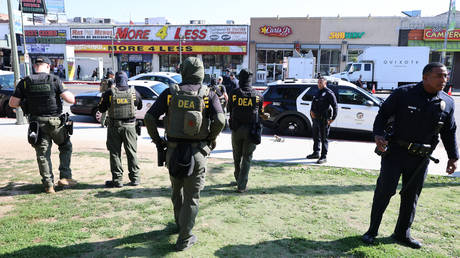
Federal agents knew the exact day a massive shipment of fentanyl pills arrived at an Albuquerque mobile home park. They had decoded the drug ring's phone conversations. They watched the handoff happen in real time. Investigators recorded that traffickers successfully moved 74,000 counterfeit pills during that single June 2023 operation.
They didn't seize a single pill.
Days earlier, the same team watched the exact same network deliver a spare tire packed tight with suspected fentanyl. Again, they did nothing. They just watched.
This wasn't a mistake. It was a deliberate, high-stakes strategy by the U.S. Drug Enforcement Administration. Between 2023 and 2025, federal law enforcement allowed hundreds of thousands of lethal doses to flow directly onto New Mexico streets. The goal was to build massive cases against top cartel bosses. But while the feds waited for the perfect moment to spring their trap, local communities paid the price in body bags.
Inside the Tactic That Trashed the Rules
Drug enforcement has a long history of "controlled deliveries." Traditionally, agents track a shipment of cocaine or marijuana, keeping it under tight surveillance or swapping the real drugs with fake lookalikes before the final destination. That way, they can follow the money and trace the entire supply chain without putting the public at risk.
Fentanyl changed the math completely.
Because a tiny speck of fentanyl can kill an adult instantly, the U.S. Justice Department enacted strict protocols back in 2017. Those rules explicitly directed agents to seize or disrupt fentanyl distribution as soon as practicable. Public safety was supposed to come first.
Instead, New Mexico became a real-world lab for a dangerous workaround. Federal prosecutors and top DEA officials chose to gamble. They prioritized catching "bigger fish" over immediate public safety, arguing that their limited resources were better spent completely dismantling entire syndicates rather than slapping handcuffs on low-level drivers.
Whistleblowers Pull Back the Curtain
Not everyone inside the agency agreed with the gamble. DEA Special Agent David Howell watched the strategy unfold with growing horror. He eventually blew the whistle, filing a formal complaint after witnessing the agency sit back and watch shipments move without intervention.
"We poisoned our community to make cases," Howell told the Associated Press. He didn't hold back, calling the agency's strategy a form of willful blindness. In his disclosures, Howell pointed out that investigators watched separate deliveries of 50,000 and 150,000 pills without stepping in. Another anonymous former DEA supervisor backed his claims, admitting that agents allowed millions of pills to hit the streets during a massive, multi-state investigation.
The human cost of these unseized pills quickly became impossible to ignore. Howell began tracking local overdose statistics, linking the very shipments the DEA let walk to local deaths. One gut-wrenching case involved a 15-month-old toddler in Española who died after ingesting burned fentanyl residue.
The Defense of the Big Bust
The agency defends its actions aggressively. DEA spokesperson Amanda Wozniak pushed back against the whistleblower accounts, claiming that suggestions the agency knowingly permitted dangerous drugs to flood communities are completely false. According to the official agency stance, these operations involved court-authorized wiretaps, rigorous surveillance, and intelligence gathering designed to safely take down massive international drug organizations.
Alex Uballez, the U.S. Attorney for New Mexico during the operations, also defended the strategy. He maintained that prosecuting entire organizations ultimately saves more lives in the long run than stopping individual transactions.
The strategy did yield a massive headline. In May 2025, federal officials announced the largest fentanyl seizure in DEA history, an operation that netted more than 3 million pills in Albuquerque.
But look at the cost. While national overdose deaths dropped by 14% last year, New Mexico saw a staggering 21% spike. The state remains the epicenter of a brutal epidemic, and its largest city features a neighborhood so ravaged by the drug trade that locals simply call it the War Zone. The Justice Department's Office of Professional Responsibility eventually cleared the DEA, ruling that the agency acted reasonably. Tell that to the families burying their kids.
How to Protect Local Communities Right Now
Relying entirely on federal law enforcement to clean up the streets clearly isn't working. True safety requires immediate, aggressive local action.
- Distribute Naloxone Everywhere: Local businesses, schools, and community centers need immediate access to overdose-reversing drugs like Narcan. Do not wait for a federal program.
- Demand Local Law Enforcement Intervention: Pressure local police departments and county sheriffs to prioritize immediate drug interdiction and public safety over long-term federal intelligence operations.
- Support Harm Reduction Hubs: Expand funding for local addiction treatment clinics and community-outreach programs that target high-risk neighborhoods directly.
- Enact Strict Local Whistleblower Protections: Ensure that local and state law enforcement officers can expose dangerous federal tactics without fear of retaliation or losing their careers.