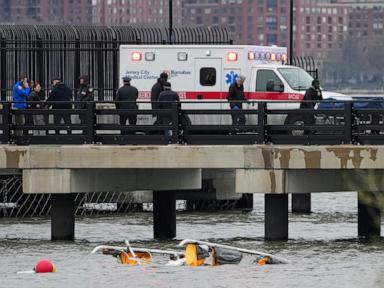
We all remember where we were when the news broke. On April 10, 2025, a tourist helicopter carrying a family of five and a pilot plummeted into the Hudson River. It took less than eighteen minutes for a routine sightseeing trip to turn into a tragedy. For over a year, everyone wondered how a reliable Bell 206L-4 helicopter could simply break apart in midair. Now, we finally have an answer, and it is a wake-up call for the entire aviation industry.
The National Transportation Safety Board released its preliminary findings, pointing directly to a massive bird strike. Investigators found the remains of several Canada geese scattered across the wreckage, including on the rotor blades and the tail.
This isn't just a freak accident. It is a stark reminder of the unique, terrifying hazards of low-altitude flight over urban waterways. When we talk about flight safety, we usually focus on engine failures or pilot error. We rarely think about a flock of heavy birds crossing paths with a seven-thousand-pound machine. But we should.
Inside the NTSB Discovery of the Hudson River Strike
The details in the NTSB report are chilling. The helicopter took off from a downtown Manhattan heliport on a clear afternoon, tracing a familiar path north along the skyline before looping south toward the Statue of Liberty. It was a route flown dozens of times a day.
Then, about seventeen minutes into the flight, things went horribly wrong.
A witness on the ground reported seeing a large flock of geese suddenly take flight near the river. Moments later, they heard loud bangs and pops echoing across the water. The helicopter didn't just lose power. It literally broke into three distinct sections before hitting the water. The fuselage, the main rotor system, and the tail boom all separated in midair.
+-------------------------------------------------------+
|             BELL 206L-4 STRUCTURAL BREAKUP            |
+--------------------------+----------------------------+
| Component                | Recovery Location / State  |
+--------------------------+----------------------------+
| Fuselage                 | Submerged in Hudson River  |
| Main Rotor System        | Separated, found in river  |
| Tail Boom                | Found 2,000 feet away      |
| Geese Remains            | Rotors & stabilizer        |
+--------------------------+----------------------------+
To confirm what happened, investigators had to rely on forensic science. They sent organic material recovered from the rotor blades and the left horizontal stabilizer to the Smithsonian Institution's feather identification lab. The results came back positive for Canada geese. These aren't small birds. A single Canada goose can weigh anywhere from eight to fifteen pounds. Hit a flock of them at a high speed, and it is equivalent to being pelted by bowling balls.
The Fatal Physics of a Low Altitude Bird Strike
Most people assume that aircraft are built to survive bird strikes. They are, but only to a point, and mostly if they are commercial airliners.
Commercial jets fly high. They encounter birds during takeoff and landing, but they have dual engines, armored windshields, and massive structural redundancy. Helicopters are a completely different story. They operate almost exclusively in the dead space where birds live, typically under one thousand feet.
When a multi-pound goose collides with a helicopter's main rotor blade, the physics are devastating. The blades are spinning at incredible speeds, often exceeding four hundred miles per hour at the tips. The kinetic energy transferred during an impact at those speeds is massive.
In this case, the impact likely caused an extreme imbalance in the rotor system. When one blade is damaged or deformed by a heavy strike, it instantly creates a violent track imbalance. The resulting vibration can be so severe that it tears the mast, transmission, and rotor assembly completely off the fuselage. That is exactly what the surveillance footage and physical wreckage suggest happened here. The helicopter literally shook itself apart in seconds.
Why Helicopters Face a Unique Danger Over NYC
We often hear comparisons to the famous Miracle on the Hudson in 2009. In that event, Captain Chesley Sullenberger successfully glided an Airbus A320 into the river after losing both engines to a flock of geese. Everyone survived.
But a helicopter is not a commercial jet. It does not glide.
If a helicopter loses its rotor system or suffers catastrophic structural failure, there is no emergency procedure that can save it. Autorotation, the emergency maneuver where a pilot uses descending airflow to keep the rotors spinning and cushion a landing, requires a functioning rotor system. If the blades are gone or severely damaged, the aircraft falls like a stone.
The airspace around New York City is incredibly crowded. You have tour operators, media choppers, medical flights, and private charters all squeezed into narrow corridors over the East and Hudson Rivers. At the same time, these waterways are major migratory paths for birds.
The Federal Aviation Administration has long acknowledged that helicopters are highly vulnerable to bird strikes due to their low operating altitudes. Yet, we continue to allow dozens of commercial tour flights to zip through these exact corridors every single day.
The Human Toll and the Aftermath of the Tragedy
Beyond the technical data, we have to look at the immense human cost of this incident. The crash wiped out an entire family.
Agustin Escobar, a forty-nine-year-old business executive from Spain who served as the CEO of Rail Infrastructure at Siemens Mobility, was on vacation with his family. His wife, Mercè Camprubí Montal, and their three young children, aged four, eight, and ten, all perished in the water. The pilot, Seankese Johnson, a thirty-six-year-old U.S. Navy veteran who earned his commercial license in 2023, was also killed.
Following the accident, the tour operator, New York Helicopter Charter Inc., ceased operations entirely. The political fallout was immediate. New Jersey's governor renewed calls for aggressive restrictions on nonessential helicopter flights over urban areas, citing both safety and noise concerns.
This tragedy highlights the massive gap between recreational tourism and public safety. Is an aerial view of Manhattan worth the risk of flying single-engine aircraft through heavy migratory bird paths? Many local leaders are starting to say no.
Why Commercial Rules Must Change Now
If we want to prevent another disaster like the April 2025 crash, the aviation industry needs to stop treating bird strikes as unpredictable acts of God. They are predictable environmental hazards.
First, we need to talk about bird avoidance technology. Commercial airliners use weather radar and bird advisory systems, but smaller helicopters lack these tools. Installing bird detection radar at major heliports could give pilots real-time warnings before they lift off into a flock of geese.
Second, fleet modernization is mandatory. Many tour companies rely on older airframe designs that do not feature the same impact-resistant composite materials found in modern military or medical helicopters.
Finally, the flight paths themselves need an overhaul. Restricting low-altitude flights during peak bird migration seasons could drastically lower the chances of another fatal collision.
The NTSB report gave us the facts. Now, the FAA and local lawmakers must decide what to do with them. We can either rewrite the rules for low-altitude urban flights, or we can wait for the next tragedy to happen over the Hudson.
If you are planning a trip to New York, skip the helicopter tour. Walk the Brooklyn Bridge, visit the observation decks, or take a ferry. The view from the ground is just as beautiful, and it is infinitely safer.


