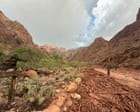
Millions of tonnes of rock, ice, and roaring meltwater obliterated entire Himalayan towns in seconds. At least 800 people lost their lives, and roughly 3,000 vanished into the grey sludge of a catastrophic glacial outburst. While the immediate trigger was a massive bedrock fracture high in the mountains that registered as a magnitude 5.2 earthquake, the political fallout has reached all the way to Washington.
Jeremy Konyndyk, a former disaster-response chief for USAID, didn't mince words. He pointed a direct finger at Donald Trump's administration and its aggressive federal spending cuts. According to Konyndyk, the cost-cutting crusade led by the Department of Government Efficiency, widely known as DOGE, slashed critical early-warning and disaster-mitigation programs that might have given communities in Nepal a fighting chance. For another view, check out: this related article.
When you start tearing up international grants using keyword filters to hunt down environmental projects, bad things happen downstream.
Where the Funding Axe Fell
During Trump's tenure, tech billionaire Elon Musk oversaw an intense slashing spree targeting foreign assistance and environmental oversight. Roughly $60 billion vanished from US foreign aid budgets. Among the casualties was a vital collaborative initiative connecting USAID and NASA. Related analysis regarding this has been shared by TIME.
That specific project wasn't just abstract academic research. It focused heavily on:
- Flood prediction models
- Early warning systems
- Disaster readiness training
- Comprehensive glacier inventories
- Mapping dangerous glacial lakes across Nepal
Konyndyk, who previously managed USAID's response to the devastating 2015 Nepal earthquake, noted that DOGE completely canceled seven separate disaster risk reduction projects in the country. On top of that, about $420 million worth of climate-related work at NASA got wiped out.
Could these exact initiatives have stopped a massive mountain peak from breaking apart? Honestly, probably not. Glacial collapses of this scale are freakish, outlier events. But predicting them and evacuating people before the flash flood hits? That is literally what those programs were built to do.
The Cost of Climate Skepticism
It's hard to prepare for natural hazards when the people holding the purse strings openly mock the science behind them.
The Trump administration has spent years downplaying global heating. Trump himself has famously dismissed climate change as a hoax and claimed wind turbines drive marine mammals crazy. When your core ideology treats environmental science as a political conspiracy, funding preventative safety measures in fragile regions looks like an easy target for budget cuts.
Yet, the Himalayan region warms significantly faster than the global average. Nepal contributes a microscopic fraction—roughly 0.1 percent—to global carbon emissions. Despite this, its citizens pay the highest possible price for a crisis they didn't create. Nepali Foreign Minister Shisir Khanal pointedly called for global solidarity, noting that his country bears a disproportionate burden of a warming planet.
What Happens Next
Pointing fingers after a tragedy doesn't bring back the missing thousands. But it does expose the real-world consequences of political budget cuts. When foreign aid gets treated as a wasteful line item instead of a life-saving safety net, remote mountain valleys are left entirely defenseless against sudden ecological collapse.
If you want to understand how political decisions in Washington ripple across the globe, look straight at the muddy riverbeds of the Himalayas. Prevention costs pennies compared to search and rescue operations, yet the current political playbook keeps choosing to save the pennies and spend the lives. Stop treating disaster reduction as optional overhead. Restore funding for frontline international monitoring before the next mountain ridge gives way.