Stop calling LS Lowry a naive painter. It's an insult to an artist who spent years in art school studying under French Impressionists. The myth of the isolated, uncultured rent collector who just happened to doodle "matchstick men" after his day job needs to die.
Thankfully, a major new exhibition is about to smash that narrative completely.
Opening on October 24 at the MK Gallery in Milton Keynes, LS Lowry: the Theatre of Life brings together 140 works to challenge decades of lazy typecasting. It turns out Lowry wasn't some folk-art anomaly hiding out in the industrial North. He was a highly cultured, deliberate artist who went to the opera, collected works by Lucian Freud and Jacob Epstein, and knew exactly what he was doing with a brush.
If you think Lowry only painted bleak, smoking chimneys and depressed crowds, you've missed the bigger picture.
The Myth of the Self Taught Outsider
The art establishment has always struggled with Lowry. Because his figures look stripped-back and simple, critics often slapped him with terms like "naive" or "Sunday painter." It's a patronizing view that completely ignores his actual biography.
Lowry spent years in formal art education. He took evening classes at the Salford School of Art and the Municipal College of Art in Manchester. Crucially, he studied directly under Pierre Adolphe Valette, a brilliant French Impressionist painter. Lowry himself admitted he couldn't overestimate Valette’s effect on him.
He didn't paint like a classic Impressionist because he chose not to. Instead, he took the Impressionist obsession with capturing modern urban life and applied it to the harsh reality of industrial Lancashire.
He used a strict, self-imposed palette of just five colors:
- Vermilion
- Ivory black
- Prussian blue
- Yellow ochre
- Flake white
Limiting your entire output to five tubes of paint isn't the sign of an uneducated amateur. It's the mark of an incredibly disciplined artist executing a specific aesthetic vision.
A Football Match Unearthed After 84 Years
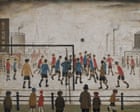
The upcoming MK Gallery show isn't just a rehash of his famous industrial cityscapes like Coming Out of School or The Pond. The real headline here is the inclusion of a rarely seen 1932 masterpiece titled A Football Match.
This painting hasn't been displayed in public for nearly 85 years. The last time anyone saw it outside of a private collection was at the Royal Academy back in the 1940s. While Lowry was a massive Manchester City fan, A Football Match doesn't show a famous stadium. Instead, it captures an amateur game between two anonymous teams surrounded by an intense, packed crowd.
Anthony Spira, director of the MK Gallery, points out that the show intends to reveal Lowry's obsession with classic English social life. He wasn't just recording the misery of the factory floor. He was recording leisure. He painted seasides, festivals, and people actually having fun.
"He was much more cultured and engaged than he's given credit for," Spira notes, aiming to rescue the artist from becoming a negative caricature of himself.
Why the Art World Got Him So Wrong
We love a simple story. The British art world preferred the narrative of the eccentric rent collector who painted out of pure instinct. It made for great copy, especially when paired with the rediscovered interviews featured earlier this year in the BBC documentary LS Lowry: The Unheard Tapes, where Sir Ian McKellen brilliantly brought the artist’s private thoughts to life.
Lowry did collect rents for four decades. He did paint late into the night after a long day of walking the streets of Salford. But his day job didn't make him uncultured; it gave him an unprecedented front-row seat to the human condition. He watched how crowds moved, how people leaned into the wind, and how communities gathered.
When you see 140 of his paintings together this autumn, the technical skill becomes impossible to deny. His white backgrounds—originally suggested by Manchester Guardian critic D.B. Taylor to lighten his early, sombre palette—create a deceptive sense of space. The crowds aren't just random strokes. They are carefully balanced compositions using what Lowry called "painter's mathematics."
How to Experience the Real Lowry This Year
If you want to look past the matchstick myth and judge the work for yourself, plan your itinerary around these key steps.
- Book MK Gallery Tickets Early: LS Lowry: the Theatre of Life opens October 24 in Milton Keynes. Given the rare appearance of A Football Match, slots will fill up fast.
- Visit Salford Quays: Head to The Lowry arts centre in Salford to see his permanent collection, including Going to the Match, which the gallery saved for the public in 2022 for £7.8 million.
- Look for the Space, Not Just the Figures: When standing in front of a Lowry canvas, ignore the people for a moment. Look at the architecture, the tonal relationships in the gray skies, and the deliberate geometry of the buildings. That's where his true mastery hides.
Lowry wasn't an isolated amateur begging for validation from London galleries. He was an artistic rebel who looked at the smoke, the noise, and the grit of the working-class North and decided it was just as worthy of high art as a Parisian lily pond. It's time we finally started treating him like one.