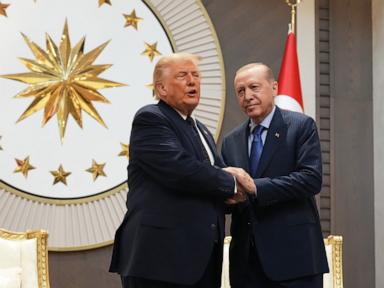
NATO just threw a massive, multi-billion-dollar weapons party in Turkey, and the guest of honor remains completely unimpressed.
If you think the transatlantic alliance is just about military strategy, the latest summit in Ankara proves it's also about desperate political marketing. NATO leaders rolled out the red carpet, pumped up the techno music, and flashed eye-popping figures across massive screens. The goal was simple. They wanted to prove to US President Donald Trump that European allies aren't freeloaders. They wanted to show that the alliance can hunt, fight, and pay its own way.
It didn't work.
Before Air Force One even touched down at the summit, Trump made his position clear. He doesn't care about spreadsheet metrics or shiny procurement charts. When NATO Secretary-General Mark Rutte tried to wave a chart called "The Trump Trillion"—proudly showcasing $1.2 trillion in allied defense spending since 2017—Trump essentially yawned.
"We don’t need their money," Trump told reporters. "I just want loyalty."
This simple interaction cuts to the heart of what most analysts get totally wrong about the current state of Western security. Europe thinks it can solve its American problem by writing checks to defense contractors. Trump wants unconditional political alignment, specifically regarding his military actions in the Middle East.
The High Stakes Show in Ankara
The backdrop for this geopolitical drama couldn't be more intense. Held inside President Recep Tayyip Erdogan’s sprawling palace compound in Ankara, the summit takes place at a moment of extreme global friction. Outside the palace gates, Turkish police dragged away student protesters. Inside, alliance leaders tried to spin a story of unity and raw power.
NATO doesn't actually own weapons. The alliance relies on its 32 member states to buy and maintain their own gear. But the collective organization does maintain a tiny, collective fleet of eyes in the sky. Right now, that fleet consists of 14 AWACS early warning radar surveillance planes that are roughly half a century old. They're practically flying museums.
To kick off the summit, Rutte and a 10-nation consortium announced a massive deal to replace those aging relics. Swedish Prime Minister Ulf Kristersson took the stage to announce that Swedish manufacturer Saab will supply up to 10 new GlobalEye surveillance aircraft.
It was a highly choreographed moment. Leaders shook hands, slapped shoulders, and grinned for the cameras. They wanted the world—and specifically the man from Mar-a-Lago—to see real hardware changing hands.
But look past the stage management. The real story isn't the planes themselves. It's how Europe is scrambling to fund them. A significant portion of these new projects will rely on a new European Union system of cheap loans. The EU is raising up to $170 billion on capital markets specifically for defense. Think about that for a second. The continent is going deep into debt just to build a military buffer that might appease an American president who openly calls NATO a "paper tiger."
Buying Hardware to Buy Loyalty
The buying spree didn't stop with Sweden. A separate group of 15 nations announced a joint effort to purchase air-to-air refueling and transport planes from Airbus. Immediately after, Rutte announced a four-country deal to buy five new Triton surveillance drones from US manufacturer Northrop Grumman.
Rutte pitched this masterfully. He noted that these drones are creating jobs on both sides of the Atlantic. It was a direct play to Trump’s "America First" manufacturing agenda. The alliance is essentially saying, Look, we’re spending money, and a lot of it is going right back into the pockets of US defense firms.
European defense spending has surged in a way that would have been unthinkable a few years ago. In real terms, European members and Canada spent $90 billion more on defense in 2025 compared to 2024. That brought their total to a staggering $570 billion.
Yet, Trump’s team views this as too little, too late. The Pentagon is already quietly moving past old spending arguments to promote an entirely new concept. They call it "NATO 3.0."
Under this framework, Washington expects Europe to handle its own backyard entirely. The US military wants to free up its resources, ships, and personnel to focus almost exclusively on China and the Indo-Pacific region. If Russia launches a hybrid attack or a conventional strike on eastern Europe, the Pentagon's message is clear. You handle it. We’re busy elsewhere.
The Real Reason Trump is Unimpressed
Why is Trump completely cold to a half-trillion-dollar European defense budget? The answer lies in the Middle East, not Europe.
Earlier this year, the United States launched a highly controversial war against Iran alongside Israel. Washington didn't bother consulting its European allies before pulling the trigger. The war rocked European economies and caused massive domestic political backlash across the continent.
While European governments quietly allowed the US to use their airspace and military bases, most refused to send troops or join the fight directly. Trump hasn't forgotten that. He views their hesitation as a deep betrayal.
To Trump, an ally who spends 3.5% of their GDP on defense but refuses to fight America's wars is useless. He prefers a country that spends less but follows orders blindly. It's about transactional fealty.
Look at the UK as a prime example of the financial pain this causes. The British government committed to hit a defense spending target of 3.5% of GDP by 2035. But they don’t actually have a concrete plan to pay for it. Their current plan only gets them to 2.7% by 2029. To close that gap, British taxpayers face massive tax hikes or deep cuts to public services.
Imagine telling a schoolteacher in Manchester that her school budget is being cut so the country can buy more missiles, only for the US president to declare the entire effort worthless because the UK didn't send troops to Tehran. That's the political nightmare European leaders face.
Inside the Weapons Basket
Let's look closely at what NATO actually threw on the table during this Ankara meeting to understand the military reality behind the political theater.
NATO Procurement Push (Ankara Summit)
-----------------------------------------------------------------
System                  Provider          Purpose
-----------------------------------------------------------------
GlobalEye Aircraft      Saab (Sweden)     Early warning & radar
Triton Drones           Northrop (US)     High-altitude surveillance
A330 MRTT Tankers       Airbus (Europe)   Aerial refueling/transport
Anti-Drone Systems      Multinational     Countering loitering munitions
-----------------------------------------------------------------
The anti-drone initiative is particularly telling. Rutte announced that allies will pump more than $40 billion over the next five years into anti-drone capabilities alone. The war in Ukraine showed everyone that cheap, off-the-shelf quadcopters and Iranian-designed loitering munitions can paralyze multi-million-dollar armor columns. Europe is desperately trying to catch up to this reality.
On top of that, the alliance is sticking to its guns on Ukraine, pledging another €70 billion ($80 billion) for 2026. They're hoping this massive package will keep the front lines stable while they sort out their internal drama with Washington.
The Battle for the Turkish Air Force
The most explosive sideshow at the summit involves the host nation, Turkey. Trump arrived in Ankara hinting that he might bring a massive gift for Erdogan. He is reportedly considering letting Turkey back into the F-35 stealth fighter jet program.
Washington kicked Turkey out of the elite fighter program back in 2019 after Erdogan bought S-400 missile defense systems from Russia. The Pentagon feared the Russian hardware could spy on the F-35's stealth capabilities.
Now, Trump wants to reverse that ban. It’s a move that has sent shockwaves through the Middle East.
Israeli Prime Minister Benjamin Netanyahu publicly blasted the idea on American television right before the summit. Netanyahu warned that selling F-35s to Turkey would completely shatter the regional balance of power. Erdogan has been fiercely critical of Israel's military actions, openly calling for the isolation of the Israeli government. Netanyahu relies heavily on absolute air superiority guaranteed by US-made jets.
If Trump overrides the Pentagon and hands the keys of the F-35 back to Turkey, it proves that his foreign policy is driven entirely by personal relationships with foreign leaders, rather than institutional alliance structures. It undermines the exact institutional strength that NATO is trying to project with its multi-billion-dollar contract announcements.
What Happens Next
European defense strategists need to stop playing a game they can't win. You can't buy off a transactional populist with a defense contract signed three years ago and repackaged as new news.
If European capitals want real security, they must stop looking to Washington for validation. They need to focus their defense spending on genuine operational independence.
First, stop building forces designed purely to integrate into US-led operations. Europe needs its own independent logistics, its own satellite reconnaissance, and its own deep-strike capabilities.
Second, fix the financing. Relying on emergency EU capital market loans to fund basic defense needs is a band-aid solution. National budgets must permanently adjust to the reality of a hostile Russia and an indifferent America.
The era of the American security umbrella is effectively over, regardless of how many multi-billion-dollar ceremonies NATO organizes in luxury palace compounds. The sooner Europe accepts that reality, the sooner it can build a military apparatus that doesn't rely on the whims of a single politician in Washington.
Trump weapons deal with NATO
This video provides essential context on Donald Trump's transactional approach to military equipment sales and alliance funding.