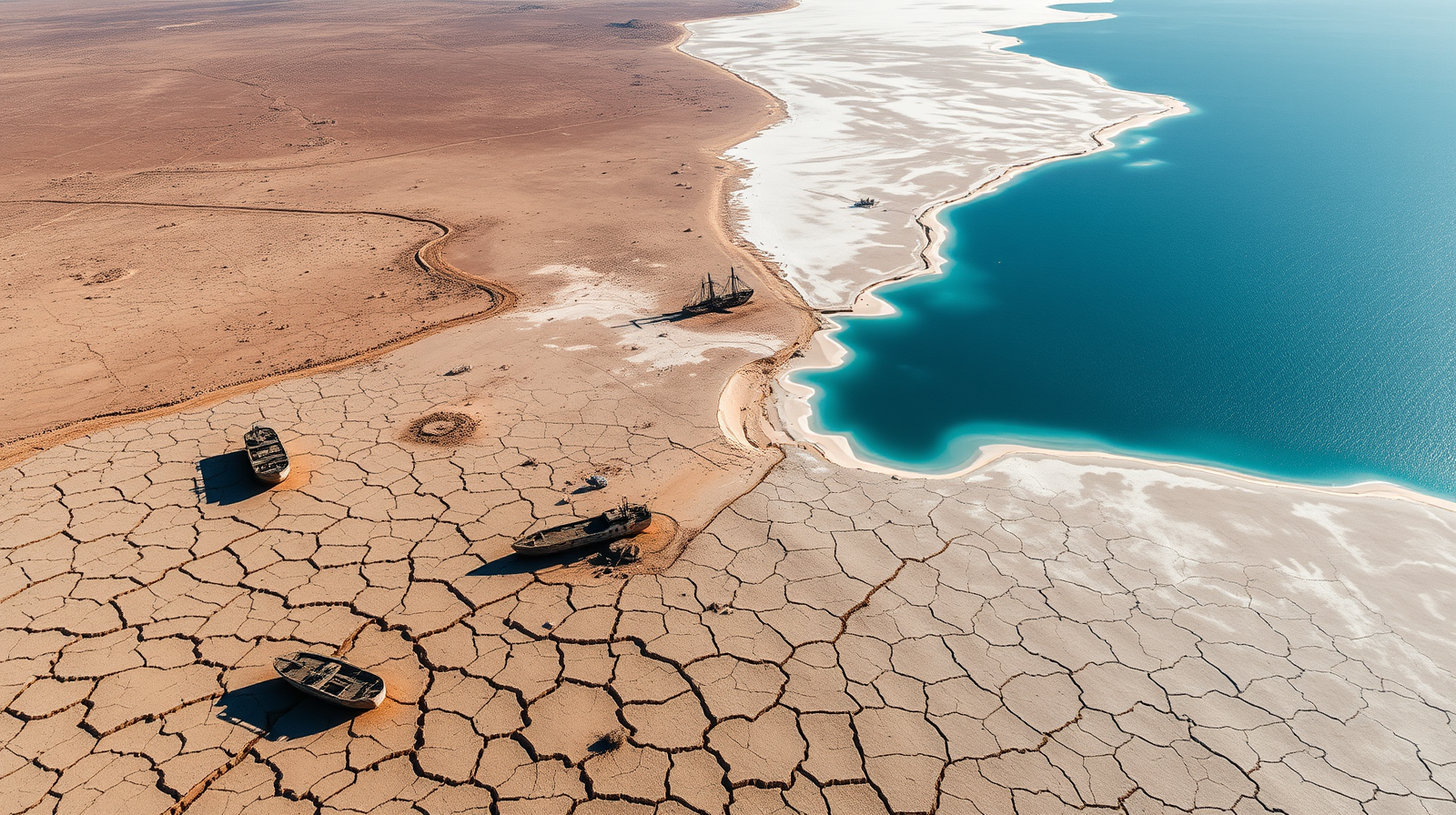
When people talk about the Aral Sea, they usually talk in past tense. They describe a body of water that simply ceased to exist, swallowed whole by human greed and Soviet engineering hubris. You've probably seen the haunting photos of rusted fishing boats sitting stranded in miles of baked desert dust.
It makes for a great tragedy narrative. But it leaves out the most surprising part of the story.
The Aral Sea isn't entirely dead. While the southern portion sitting in Uzbekistan remains a toxic salt flat, the northern section in Kazakhstan tells a radically different story. Water is returning. Fish populations are booming. Fishing villages that were stranded decades ago are watching the shoreline crawl back toward their doorsteps.
Understanding what happened here isn't just a history lesson in ecological destruction. It's a practical blueprint for how damaged ecosystems can actually be saved when nations decide to act.
How Soviet Cotton Diversions Drained an Inland Sea
To understand the comeback, you have to look at how fast the collapse actually happened. Back in the 1950s, the Aral Sea was the fourth-largest lake on Earth. It covered 68,000 square kilometers between Kazakhstan and Uzbekistan, fed by two major rivers: the Syr Darya from the north and the Amu Darya from the south.
Then Moscow stepped in. Soviet planners wanted to make Central Asia a global hub for cotton, which they called white gold. To irrigate vast desert fields, engineers diverted both feeder rivers into thousands of miles of unlined, leaky canals.
By the 1960s, the water level began dropping fast.
"Soviet engineers knew the lake would dry up someday. They simply didn't care. There was no public debate, and anyone who raised concerns was ignored."
— Former Kazakh regional water officials
By 1987, the water level had dropped so far that the lake split into two distinct bodies: the Small Aral Sea in the north and the Large Aral Sea in the south. By the mid-2000s, the sea had lost more than 90 percent of its volume. The exposed seabed became the Aralkum Desert, a blinding expanse of salt contaminated with toxic agricultural pesticides washed down from cotton farms.
Local weather patterns collapsed. Without the lake's massive surface area to moderate regional temperatures, summers became scorching hot and winters grew bitterly cold. Blinding dust storms began blowing over 100 million tons of toxic salt across neighboring towns every year, triggering skyrocketing rates of respiratory diseases and cancers among local residents.
The Engineering Gamble That Saved the North
By the late 1990s, global environmental organizations had essentially written off the Aral Sea as a lost cause. Restoring the entire lake would have required shutting down regional agriculture completely and allowing the Amu Darya and Syr Darya to flow freely for 40 straight years. Politically and economically, that was never going to happen.
Kazakhstan decided on a pragmatically brutal strategy: cut off the south to save the north.
In 2005, with $83 million in backing from the World Bank and the Kazakh government, construction finished on the Kok-Aral Dam. This 13-kilometer concrete barrier blocked the Syr Darya river's water from spilling south into the hyper-saline desert floor where it would instantly evaporate.
The results were almost instant.
Within just eight months, water levels in the North Aral Sea rose by over 3 meters. The surface area expanded by roughly a third in less than a year. The incoming river water flushed out accumulated minerals, dropping salinity levels back to near pre-1960s levels.
Biological Life Returns to the Water
When salinity dropped, native life returned.
During the worst years of the collapse, salinity topped 100 grams per liter—roughly three times as salty as the ocean. Almost every native fish species vanished. Only the European flounder, a flatfish introduced in the 1990s to give local communities anything at all to catch, survived the brutal chemical shift.
Today, the ecological reset is staggering.
- 22 Native Species Restored: Fish like pikeperch, carp, and bream migrated back out of the Syr Darya delta and repopulated the lake.
- Catch Rates Skyrocketed: Commercial fish catches went from a miserable 600 tons in the mid-1990s to over 8,000 tons annually in recent years.
- Climatic Relief: Local microclimates stabilized, bringing back localized rain clouds and softening winter temperature drops around the northern shore.
Port cities like Aralsk, which sat more than 100 kilometers away from the retreating shoreline during the low point, have seen the water creep back to within roughly 20 kilometers. Processing plants that stood abandoned for three decades are operating again, exporting freshwater fish directly to European markets.
Why the Southern Basin Remains Beyond Recovery
If the northern recovery sounds like a simple fairy tale, the southern half brings you back to reality.
The South Aral Sea sits primarily in Uzbekistan, where cotton remains a massive state industry. The Amu Darya river, which fed the southern basin for thousands of years, is still almost entirely consumed by heavy irrigation before it ever reaches the old shoreline.
Without a steady inflow, the southern lake continued fragmenting. By 2014, NASA satellite imagery showed the massive eastern basin of the southern sea had completely dried up. It's now a permanent desert.
The lesson here is simple and stark. Ecological recovery isn't impossible, but it requires a conscious trade-off. Kazakhstan succeeded because it accepted losing part of the sea to concentrate limited water resources where they could actually do good. Uzbekistan kept prioritizing industrial agriculture, leaving its portion of the basin to evaporate into history.
What Environmental Restoration Really Requires
The partial rebirth of the Aral Sea gives us an honest look at what works in real-world environmental management.
- Focus on realistic targets. Trying to restore a massive ecosystem back to its historic 1950s boundaries is often impossible. Concentrating resources on small, viable sub-zones yields actual results.
- Infrastructure matters. The original informal sand dikes built by local residents in the 1990s repeatedly washed away. It took proper civil engineering—the Kok-Aral Dam—to lock in long-term success.
- Fix upstream efficiency first. Kazakhstan didn't just build a dam; they modernized irrigation canals along the Syr Darya to ensure actual water reached the river mouth instead of leaking into sandy soil.
Kazakhstan is currently expanding the Kok-Aral Dam to raise water levels further, aiming to bring the shoreline within striking distance of old port infrastructure. It won't fix the whole disaster, but it proves that environmental destruction isn't always a permanent sentence.