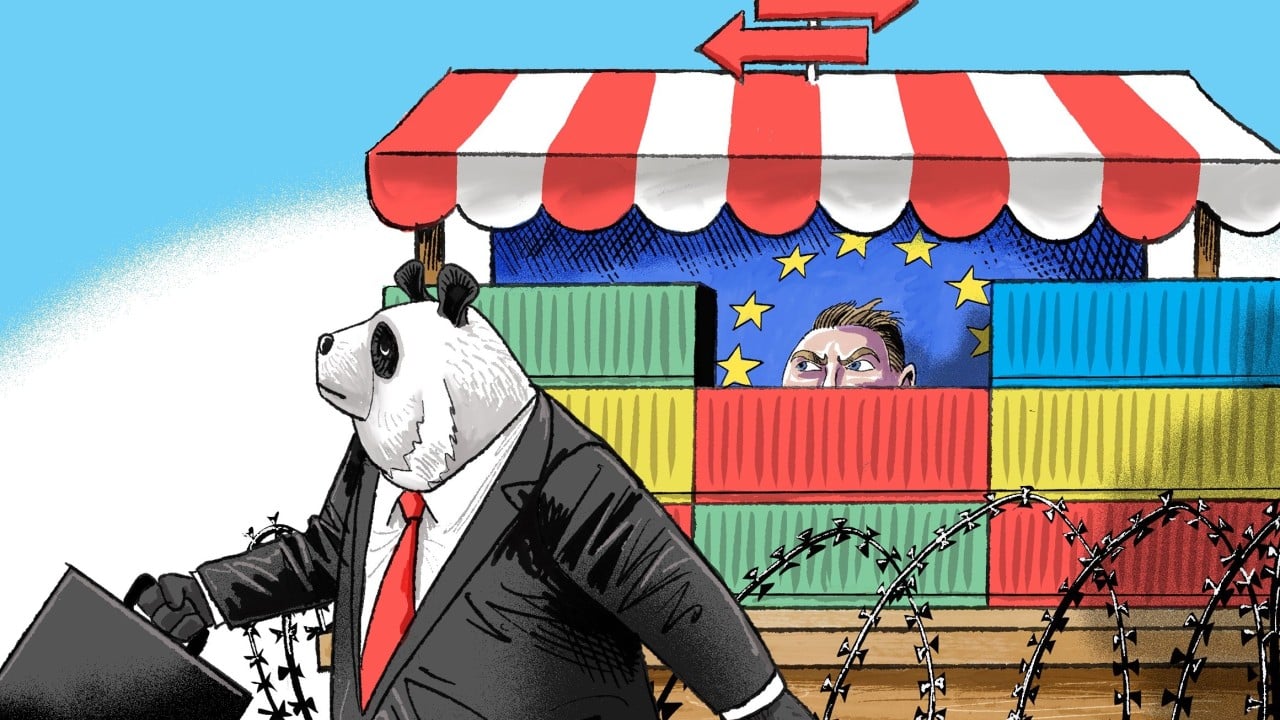
Brussels is playing a dangerous game. For months, European officials have dropped heavy hints about cracking down on clean energy imports, slapping massive tariffs on electric vehicles, and tightening market regulations. They call it de-risking. They frame it as protecting local industry from state-subsidized foreign competition. But let's call it what it really is. It's an attempt to weaponize the massive European consumer market to force Beijing's hand.
It won't work out the way they think.
When you look at the cold numbers, Europe needs China far more than its political rhetoric suggests. The European Union has set ambitious climate goals. They want millions of electric cars on the road, massive solar grids stretching across the continent, and advanced battery storage facilities powering industrial hubs. Achieving this without Chinese supply chains is mathematically impossible right now.
The Illusion of European Self Reliance
Many policymakers in Brussels believe the EU market is so large and attractive that foreign exporters will simply absorb any punishment to keep access. It's a fundamental misunderstanding of modern trade dynamics. China isn't the isolated manufacturer it was twenty years ago. It controls the raw materials, the processing pipelines, and the engineering scale that make the green transition affordable.
Take the solar industry. Recent trade figures show that Chinese companies produce over 80 percent of the world's solar components. In specific parts of the supply chain, like wafer manufacturing, that market share climbs past 95 percent. If the EU moves forward with its threatened crackdowns on solar imports, European project developers won't suddenly find local alternatives. They will just watch their project costs skyrocket.
We saw a hint of this disruption when European buyers scrambled during recent summer heatwaves. Brands like Midea saw their portable air conditioners sell out completely across heat-stricken European cities. Why? Because European manufacturing can't match the speed, price, and volume of Chinese factories. When the weather gets hot, consumers care about getting a functioning cooling unit today, not an industrial strategy paper from Brussels.
The situation is even more critical in the automotive sector. The EU recently imposed provisional tariffs on Chinese electric vehicles, aiming to protect legacy automakers in France and Germany. It's a short-sighted defensive move. Forcing companies like BYD or Geely to pay higher entry fees doesn't fix the core problems plaguing European car brands. It doesn't fix high energy costs in Germany, rigid labor rules, or the slow adoption of digital software architectures. It just buys temporary cover for companies that are already falling behind.
Retaliation Will Strike Where It Hurts Most
Trade wars are never one-sided affairs. If the EU decides to use market access as a club, Beijing has plenty of levers to pull. The Chinese Ministry of Commerce has already demonstrated its willingness to target European agricultural exports, imposing cash deposits on imports like Canadian agricultural products and launching anti-dumping probes into European pork and dairy.
For countries like Spain, France, and Denmark, these agricultural exports are worth billions of euros. Farmers wield massive political influence in Europe. Just ask any politician who has watched tractors block the streets of Brussels during a policy dispute. If Beijing shuts the door on European agricultural products, the political blowback inside the EU will be immediate and severe.
Then there is the luxury sector. European luxury giants rely on Chinese consumers for a massive chunk of their global revenue. While some fashion and jewelry brands have noted a shift in consumer preferences toward local gold and premium domestic alternatives recently, the Chinese market remains the lifeblood of European high-end retail. A targeted consumer boycott or a regulatory squeeze in Shanghai could erase billions in market value from European stock exchanges overnight.
Consider the recent warning signs in other sectors. China added dozens of foreign entities to its export-control lists, citing national security concerns. Beijing also enforced stricter 60-day payment caps in its domestic energy storage sector to build a tighter, more resilient internal network. These moves show a country preparing for economic friction. If Europe pushes too hard, China can simply restrict the export of rare earth elements, which are vital for European wind turbines, electronics, and aerospace manufacturing.
Breaking the Green Transition
You can't build a net-zero economy on protectionist foundations. The EU wants to slash carbon emissions, but its trade policy works against its environmental goals. When you look at the economics of climate change, cost is everything. If a solar panel or an electric vehicle battery costs twice as much because of trade barriers, deployment slows down. It's that simple.
European power executives understand this reality perfectly. Top heads of major French energy companies recently publicly noted that the EU must study and cooperate with Chinese energy tech rather than block it. They pointed out that China handles technological scale and deployment speeds far better than the West right now. Trying to lock out that expertise means European utilities will pay more to build less clean infrastructure.
The numbers back this up. European heavy industry is already struggling with high energy costs following the loss of cheap Russian gas. If the cost of building new renewable energy infrastructure rises due to import bans, power prices will stay high. European factories will become even less competitive on the global stage. It's a feedback loop that leads straight to deindustrialization.
What Europe Must Do Next
Weaponizing market access is a lazy substitute for a real industrial policy. If Europe wants to remain an economic superpower, it needs to stop hiding behind tariffs and start fixing its domestic structural flaws.
The first step is accepting that supply chain interdependence is a permanent fixture of the global economy. Complete decoupling is a fantasy. Instead of trying to block Chinese investments, Europe should welcome them. When Chinese battery manufacturers build factories in Hungary or Germany, they bring capital, technology, and jobs. They integrate into the local economy, making total economic warfare far less likely.
Second, the EU needs to streamline its own regulatory red tape. It takes years to get permits for a new factory or a wind farm in Europe. In contrast, Chinese projects move from concept to execution in months. Protectionism won't fix that bureaucratic inertia.
Finally, European negotiators must use upcoming trade deadlines to build a stable monitoring framework rather than issue ultimatums. Brussels set an October deadline for tangible results after recent marathon trade talks. The goal should be a joint mechanism that tracks trade flows and manages friction through negotiation, not unilateral market bans.
Stop trying to win a trade war that will only leave Europe colder, poorer, and slower to adapt. Focus on building better domestic alternatives, speed up local infrastructure approvals, and keep the channels of commerce open. That's how Europe survives in a shifting global economy.