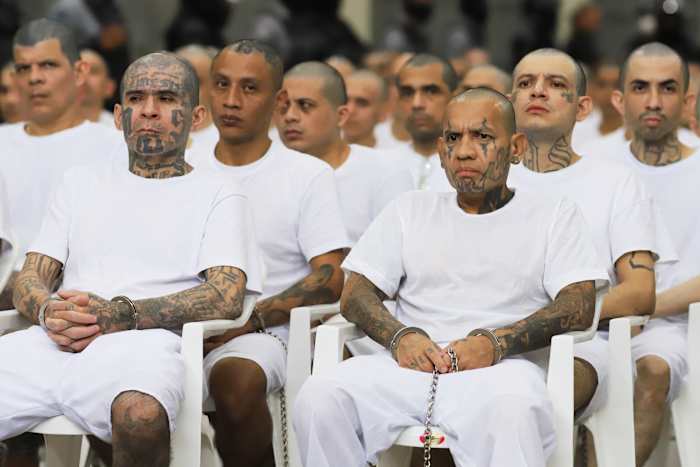
Hundreds of face-tattooed men stared blankly through video screens from their high-security cells into a courtroom they'd never physically step foot in.
This is how El Salvador wrapped up one of the largest, most controversial judicial experiments in modern history. After three months of grueling, virtual proceedings, prosecutors delivered their closing arguments, demanding maximum penalties for 485 alleged leaders of the Mara Salvatrucha, better known as MS-13.
If you think this is just a local gang crackdown in a tiny Central American country, you're missing the bigger picture. This trial isn't just about punishing criminals. It is a radical blueprint for how a state can dismantle organized crime by completely tossing out traditional legal norms.
What just finished in San Salvador is a direct challenge to the global human rights consensus.
And honestly? The rest of the world is watching very closely.
Inside the Virtual Megatrial
This isn't your average courtroom drama. There are no dramatic witness box moments or face-to-face confrontations.
The defendants, including top-tier MS-13 bosses, appeared on camera from various high-security lockups. Most are held in the Terrorism Confinement Center (CECOT), President Nayib Bukele's infamous megaprison. CECOT is a place built specifically to hold tens of thousands of gang members under conditions where visits, recreation, and education are strictly prohibited.
The scale of the accusations is hard to wrap your head around:
- 485 defendants representing the entire command structure of MS-13.
- 14,420 specific crimes prosecuted in a single collective trial.
- 444 documented killings alongside counts of extortion, drug running, human trafficking, and weapons smuggling.
- $9 million in civil damages demanded by the prosecution.
Among those on trial are the legendary founding fathers and highest directors of the gang—men like Dionisio Arístides Umanzor Osorio (known as "El Sirra de Teclas") and Borromeo Henríquez Solórzano (known as "Diablito de Hollywood"). These aren't low-level street corners dealers. They are the strategic brains who ran a transnational criminal enterprise that terrorized El Salvador and extended its reach deep into the United States.
How El Salvador Legally Reprogrammed Itself
How do you try nearly 500 people at the same time without the court system completely collapsing?
You rewrite the law.
In July 2023, El Salvador’s legislative assembly reformed the criminal code to allow mass, collective trials. Under these rules, prosecutors don't have to painstakingly prove what each individual did during a specific crime. Instead, they can group defendants together by their clique, gang faction, or geographic territory.
If you're a proven member of the MS-13 leadership, you're legally held responsible for the crimes ordered by that leadership. President Bukele has explicitly defended this approach by pointing to historical precedents like the Nuremberg trials, emphasizing the legal principle of the chain of command. If the top brass ordered a wave of violence, the top brass gets the blame for every drop of blood spilled on the street.
To secure convictions, prosecutors relied heavily on wiretapped phone calls, ballistic reports, forensic audits, and the testimony of key cooperating witnesses. During the hearings, the courtroom echoed with audio recordings of gang leaders casually ordering executions and detailing extortion rackets.
The Dark Side of the Miracle
To most people living in El Salvador, Bukele's iron-fisted strategy is nothing short of a miracle. This was once a country where gangs controlled 80% of the territory, running a parallel state that taxed every small business, dictated who could walk down which street, and drove the homicide rate to world-record highs.
Today, those gang territories are open. Children play in parks that used to be execution grounds. The security transformation is real, and it is why Bukele remains wildly popular.
But human rights organizations warn that the price of this safety is the death of due process.
The state of emergency, which has been in place since March 2022, suspends basic constitutional rights. The police can arrest you without an investigation, and you can be held indefinitely without seeing a lawyer.
"First, the police arrested thousands of people without investigation," says Juan Pappier, Americas deputy director for Human Rights Watch. "Now, the courts are handing down mass convictions to hundreds without credible evidence or any real chance of defense."
With over 92,480 people arrested since the crackdown began, El Salvador now has the highest incarceration rate in the world. Even Bukele has admitted that at least 8,000 innocent people were swept up in the dragnet and eventually released. Human rights groups have registered thousands of abuse complaints and documented hundreds of deaths of detainees while in state custody.
In these mass virtual trials, defendants often don't get to speak. Their defense attorneys, often state-appointed lawyers handling hundreds of cases simultaneously, have almost no time to prepare individual defenses. It is a assembly-line style of justice where the verdict is practically a foregone conclusion.
What Happens Next
The trial has wrapped up, but the judges have not yet announced when they will deliver the final verdicts. Given the sheer volume of evidence and the political weight of the case, it could take weeks or even months for the written rulings to be finalized.
But make no mistake: nobody expects these gang leaders to walk free.
The prosecution has asked for the absolute maximum sentences under the law. Because of El Salvador's tough new anti-gang penalties, some of these leaders face cumulative prison sentences that could easily stretch to hundreds of years, keeping them behind bars for the rest of their lives.
This is the second major mass trial El Salvador has executed—late last year, 45 leaders of the rival Barrio 18 gang were convicted, with one leader receiving a 397-year sentence. It won't be the last.
If you are looking for what to watch next to understand where this trend is heading, keep your eyes on these key areas:
- Watch the Export of the Model: Neighboring countries in Latin America, plagued by their own wave of cartel and gang violence, are openly debating whether to copy Bukele's state-of-emergency tactics.
- Monitor the Legal Appeals: International bodies, including the Inter-American Commission on Human Rights, are building cases against El Salvador. Watch how the Bukele administration handles growing diplomatic and legal pressure from the international community.
- Track the Megaprison Conditions: As tens of thousands of prisoners are locked away permanently in CECOT under extreme isolation, the long-term stability and security of these facilities will be put to the test.