Stop looking at traditional family structures for a second. The way people build their lives changed entirely over the last decade, and public institutions are finally starting to notice. If you think weddings are strictly a human affair, Ecuador's Civil Registry wants you to think again.
On May 13, 2026, the country officially launched an initiative that raised eyebrows across Latin America. They opened the doors to nationwide pet-friendly civil weddings. This means your dog or cat can walk down the aisle and step into the formal role of a symbolic wedding witness. They even get to sign a certificate with an ink-stained paw print. You might also find this related article interesting: Why Shopping Roundups Miss The Mark And What We Actually Used This Month.
It sounds like a quirky marketing stunt. It isn't. It's a calculated, official policy adjustment that acknowledges how modern couples view their household dynamics. If you've spent thousands of dollars on vet bills, customized pet food, and specialized training, you don't view your pet as property. You view them as family. Ecuador just became the first country in the region to codify that reality into its civil services.
The Shift Toward Multi Species Families
Traditional bureaucracy usually takes decades to catch up with societal trends. In this case, the shift happened out in the open. Government officials aren't doing this because they love cute animal videos. They're doing it because the data forced their hand. As discussed in detailed articles by The Spruce, the results are widespread.
When couples walk into the registry office now, they aren't just bringing human friends. They're bringing their companion animals. Registry Director General Otton Rivadeneira made it clear that public services must adapt to what he calls modern needs and evolving family structures. Sociologists call this the rise of the multi-species family. It's a fancy term for a simple truth. For millions of people, a pet fills the emotional and social space traditionally occupied by children or extended relatives.
Other nations in Latin America still strictly forbid anything but human witnesses on formal documents. Mexico and Argentina have allowed a few isolated exceptions under specific local judicial eyes, but Ecuador is the first to institutionalize it across all offices nationwide. It’s a direct response to a massive cultural pivot.
How Pet Friendly Civil Weddings Actually Work
Let's clear up the biggest misconception right away. Your dog is not suddenly a legally binding entity. If a couple gets divorced, the dog's signature won't hold weight in a asset-division court case. The legal framework of a marriage still requires human signatures and official state verification.
Instead, the Civil Registry issues two distinct documents during the ceremony. The first is the standard, legally binding marriage certificate that goes into the national database. The second is an official symbolic marriage certificate. This secondary document looks just as formal, but it features a dedicated, blank box labeled for the paw print of your furry friend.
During the ceremony, the registrar guides the couple through their vows. Once the human witnesses sign the primary registry, the registrar assists the couple in pressing their pet's paw onto a non-toxic ink pad. The paw is then pressed firmly into the designated box on the symbolic certificate. The pet is officially on the record as part of the union.
Meet The Couples Putting Paw Prints On Paper
The practice gained immediate traction. Since the program kicked off, dozens of couples have lined up to take advantage of the new rules. The stories coming out of these registry offices show exactly why this matters to people.
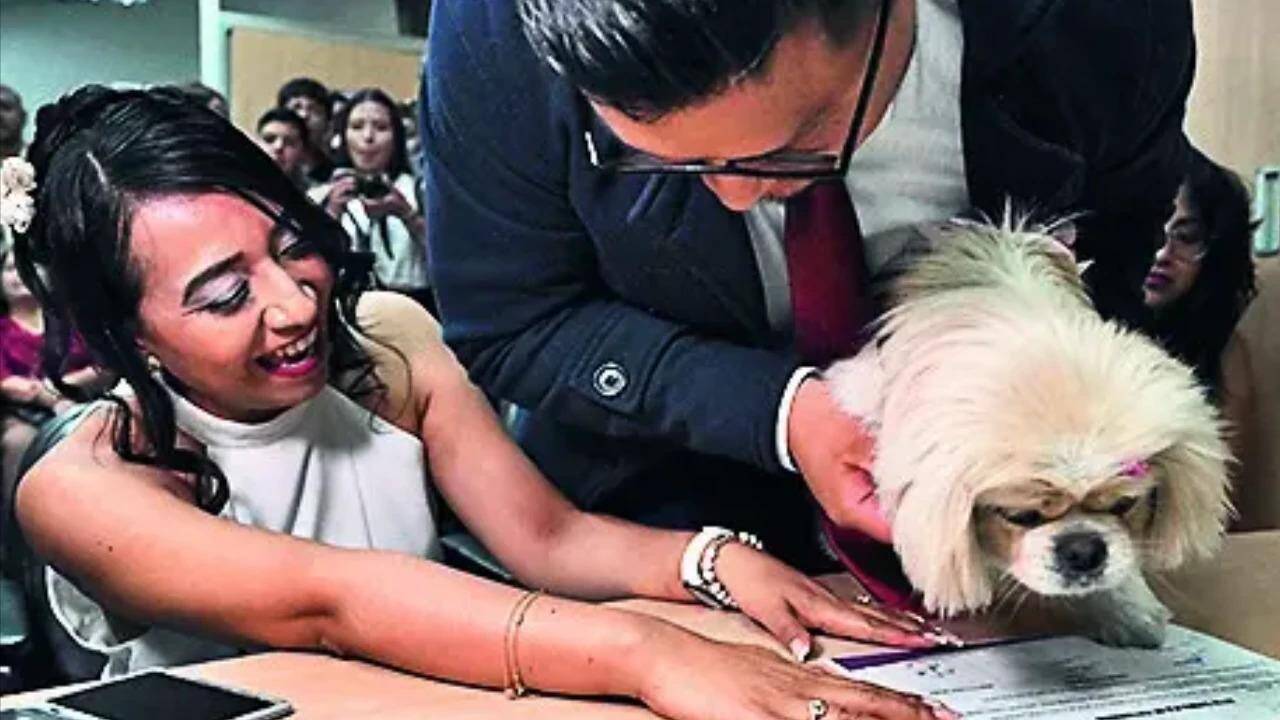
Take Diana Tupiza and Andres Alquinga. They got married in the capital city of Quito. Diana is a thirty-eight-year-old engineer, and Andres is a thirty-one-year-old programmer. When they planned their civil ceremony, Andres suggested bringing their Pekingese pup, Luna.
Luna didn't just show up. She wore a custom pink tulle gown designed and sewn specifically for the occasion by the bride’s mother, Luz Lima. Luz admitted she was shocked when her daughter first brought up the idea. Her initial reaction was practical. She told the couple that it's always better to choose a witness who actually knows what they're signing. But after seeing how much Luna meant to the couple, she came around. She realized these are simply modern times.
After the vows, Luna stamped her paw onto the certificate. For Diana, Luna represented more than just a pet. She viewed the dog as a living representative of all the animals the couple had loved, including those that had passed away.
In another Quito ceremony, Lizeth Simbaña and her partner Rubén brought their pet, Kira, to act as their primary companion witness. Lizeth summed up the sentiment perfectly after the ceremony by stating that Kira is essentially their daughter. For them, leaving her out of the official celebration would have felt like leaving out a immediate family member.
The Hard Demographics Explaining This Shift
If you think this is just a passing fad driven by sentimental millennials, the census data tells a completely different story. The numbers provided by the Ecuadorian Institute of Statistics and Censuses paint a stark picture of shifting demographics.
Ecuador has a total population of roughly nineteen million people. Within that population, there are an estimated 7.6 million dogs and cats living as household pets. Over 2.6 million households explicitly register as pet-owning homes.
Now look at the youth demographic. The number of pets in Ecuador is now almost double the total number of children aged twelve and under nationwide.
Birth rates are declining across Latin America. Meanwhile, pet ownership is skyrocketing. People are delaying marriage, having fewer kids, or choosing not to have children at all. But their desire for companionship, responsibility, and deep emotional connection hasn't disappeared. It transferred to domestic animals. The Civil Registry isn't creating a trend here. They're just looking at the census data and adjusting their service model to match the populace.
Legality Versus Sentimentality
Critics argue that allowing pets into government spaces devalues the solemnity of marriage. They claim that civil registries should remain strictly orderly places of law, not pet boutiques.
That view misses the point of what a civil wedding actually represents to the people paying for it. A wedding is a public declaration of a shared life. If a couple's daily routine revolves around walking a dog, managing vet appointments, and sharing a home with an animal, excluding that animal from the ceremony feels artificial.
The symbolic certificate bridges the gap between cold legal requirements and warm emotional reality. The state gets its valid human signatures for tax and legal purposes. The couple gets a permanent, government-stamped memento that honors the actual shape of their daily lives. It's a compromise that protects the integrity of the legal system while honoring the emotional intelligence of the citizens using it.
How To Book A Pet Friendly Civil Ceremony
The system is streamlined for couples who want to include their animals. The Civil Registry set up a clear protocol to ensure the ceremonies don't descend into chaotic barking matches.
- The Pre Wedding Interview: Couples must schedule an initial interview through the Civil Registry's Virtual Agency or walk into a local physical branch. During this meeting, you declare your intent to hold a pet-friendly wedding.
- Logistical Rules: The registry requires pets to be properly secured on leashes or in appropriate carriers until the moment of the signing. Owners must ensure their animals are comfortable in crowded public spaces to prevent disruptions.
- The Certificate Logistics: The registry provides the non-toxic, easily washable ink needed for the paw print. Couples can bring their own specialized wipes to clean their pet's paw immediately after the stamping.
The initiative is driving an uptick in marriage registry bookings. Between January and April of 2026, the Civil Registry officiated 15,771 marriages nationwide. That's a noticeable jump from the 14,087 marriages handled during the exact same timeframe in 2025. The highest numbers are concentrated in urban hubs like Pichincha and Guayas, where apartment living and multi-species households are most prevalent.
Ecuador found a way to make bureaucratic processes feel human. By treating pets as legitimate parts of the family unit, they've set a precedent that neighboring countries are already watching closely. If you're planning a wedding and your pet is the center of your world, you might want to look at how Ecuador does things. They've figured out that a marriage license is great, but a paw print makes it complete.