We love a good doomsday story. There is something strangely comforting about imagining our own extinction, especially if we get to design a sleek, steel tombstone to mark the spot. That is exactly what the people behind Earth's Black Box tapped into when they first pitched an indestructible climate flight recorder five years ago.
The idea went viral instantly. Late-night hosts joked about it. The internet treated it like a prop from a sci-fi film. Then, total silence. For years, nothing happened. The hype died, and most people assumed the project was just another piece of vaporware or a clever marketing stunt meant to shock people during the COP26 climate talks.
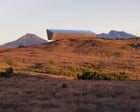
It wasn't a stunt. Assembly is finally underway, and the massive monolith is scheduled for installation near Queenstown on the edge of a remote western Tasmanian airfield.
If you are looking for a silver lining, you will not find it here. The box is not built to save us. It is built to document our failure with cold, mathematical precision. While the media loves the sensational narrative of an apocalypse recorder, the real story here is about accountability, institutional collapse, and the strange psychology of archiving our own demise.
The Monolith in the Mud
The physical structure is designed to look intentional, heavy, and completely out of place. It is a 16-meter-long, four-meter-high steel block topped with a massive array of 36 solar panels protected by toughened glass. They are planting it on a 500-million-year-old granite outcrop on the wild west coast of Tasmania.
The choice of location is not accidental. Tasmania is geologically quiet and politically stable. It is insulated enough to survive systemic global collapses that would knock out infrastructure in North America or Europe, yet connected enough to pull data from the global grid until the very end.
Inside the three-inch-thick reinforced steel shell sits a bank of storage drives and power cells. A built-in electronic heartbeat will pulse constantly. It is a signal to anyone wandering the ruins of the future that the machine is alive, watching, and writing.
The creators say the vault will withstand fire, floods, and physical impact. It cannot survive the planet literally cracking in half, but it can survive the slow, messy unraveling of human civilization. It is built to keep recording for at least 50 years, though the team is actively trying to figure out how to extend that timeline to hundreds or thousands of years using multiple data encoding formats like binary code.
What the Box is Actually Recording
A lot of people misunderstand what this device does. They think it is just a weather station. It is much more sinister than that. The project divides its tracking into two distinct categories: primary scientific data and contextual human discourse.
On the scientific side, the box aggregates what the creators call Earth's Vital Index. It pulls automated feeds of:
- Atmospheric carbon dioxide concentrations
- Global land and ocean temperatures
- Marine biodiversity loss and mass extinction rates
- Sea level rise and ocean acidification metrics
- Total global military spending
The second data stream is where the real bite lies. The box is actively scraping the internet for contextual data. It records political speeches, policy commitments, international climate treaties, news articles, tweets, and social media commentary.
The goal is to pair the physical decline of the planet with the exact words of the people who let it happen. If a world leader stands on a stage and promises net-zero emissions while quietly approving new fossil fuel projects, the black box logs both the speech and the subsequent spike in emissions. It is a ledger of hypocrisy.
Performance Art or Real Science
When you look closely at the coalition behind the project, the cracks in its scientific authority start to show. The box is not a government initiative. It is not funded by the United Nations or a global coalition of climate research centers.
The project was dreamed up by Rouser Lab, an Australian activist communications agency, alongside Clemenger BBDO Melbourne and an arts collective called The Glue Society. It is art disguised as infrastructure.
That distinction has already caused real friction. The University of Tasmania was originally affiliated with the project, lending it a much-needed veneer of academic credibility. However, the university quietly dropped out during the years of silence and requested its name be removed from the project website.
When institutions with real reputations to protect back away from a project, it is usually a sign that the line between actionable utility and high-concept public relations has blurred. The local mayor in western Tasmania openly admits he views the monolith primarily as a future tourist attraction. It will pull travelers into a rugged, economically depressed former mining region.
So, is it a gimmick? Partially. Rouser Lab boasts about generating billions of media impressions worldwide with their climate interventions. They are also planning a second installation called a techno-obelisk that will constantly beam a climate distress signal into deep space. They know how to weaponize existential dread for clicks.
But dismissing it as a mere PR stunt misses the point. Even if the project began as a provocative creative campaign, the physical reality of a massive steel vault burying itself in Tasmanian granite makes it real. The data it collects is open-source. It functions as a centralized, unalterable mirror.
The Myth of Future Archivists
The entire premise of Earth's Black Box rests on a massive assumption: that some future intelligence will find it, understand it, and care.
We love to imagine an alien spaceship landing on a barren Earth, sweeping a scanning laser over the Tasmanian airfield, and downloading our tragic story. Or perhaps a new species of intelligent mammal evolves millions of years from now, decodes the binary files, and learns not to repeat our industrial mistakes.
That is an incredibly arrogant way to look at history. Look at how we interact with the ancient ruins of our own planet. We look at Mayan glyphs or the structures of Göbekli Tepe and argue endlessly about what they meant. We turn them into legends, myths, and tourist traps.
If human civilization collapses under the weight of climate volatility, the survivors will not be looking for an open-source data platform to analyze 21st-century policy failures. They will be looking for clean water and arable land. A steel box blinking in the mud will either be ignored or stripped for its metal.
The real audience for the black box is not the future. It is us, right now.
The Accountability Trap
The box is a psychological trick. By creating a physical monument to our potential demise, it forces us to confront the permanence of our choices.
Right now, climate policy is defined by a lack of immediate consequences. Politicians sign agreements that mature long after they leave office. Corporations set sustainability goals for 2050 because no one can fire a CEO today for missing a target thirty years away. The human brain is notoriously terrible at processing slow, systemic, long-term threats.
The black box changes the timeline. It acts as an independent ledger that outlives the political cycle. The creators are explicitly trying to induce a sense of healthy paranoia in global leaders. The knowledge that your specific inaction is being written into an indestructible vault on the edge of the world is a powerful psychological weight.
It is a desperate attempt to manufacture accountability where none exists. Traditional systems of governance are failing to halt emissions. International climate summits have turned into corporate networking events. If laws and protests cannot force change, perhaps the threat of permanent historical shame will.
What Happens Next
The parts are being assembled. The concrete is being prepped. By the end of this year, the steel box will be a permanent fixture of the Australian landscape.
You can look at this project in two ways. You can see it as the ultimate expression of climate doomism—a white flag made of three-inch steel, proving we have already given up on fixing the present and are now just writing our collective suicide note.
Or you can see it as a brutal piece of mirror therapy.
If we manage to stabilize the climate, transition our energy grids, and avoid systemic collapse, the box becomes an expensive, slightly embarrassing monument to an apocalypse we managed to dodge. It will sit in Queenstown as a historical curiosity, a reminder of how close we came to the edge.
If we fail, the box keeps clicking. The solar panels will collect the fading light through a thickening atmosphere, the storage drives will log the rising parts per million of carbon, and the electronic heartbeat will pulse in the silence.
The machine is ready. The ledger is open. What we choose to write in it over the next decade is entirely up to us.