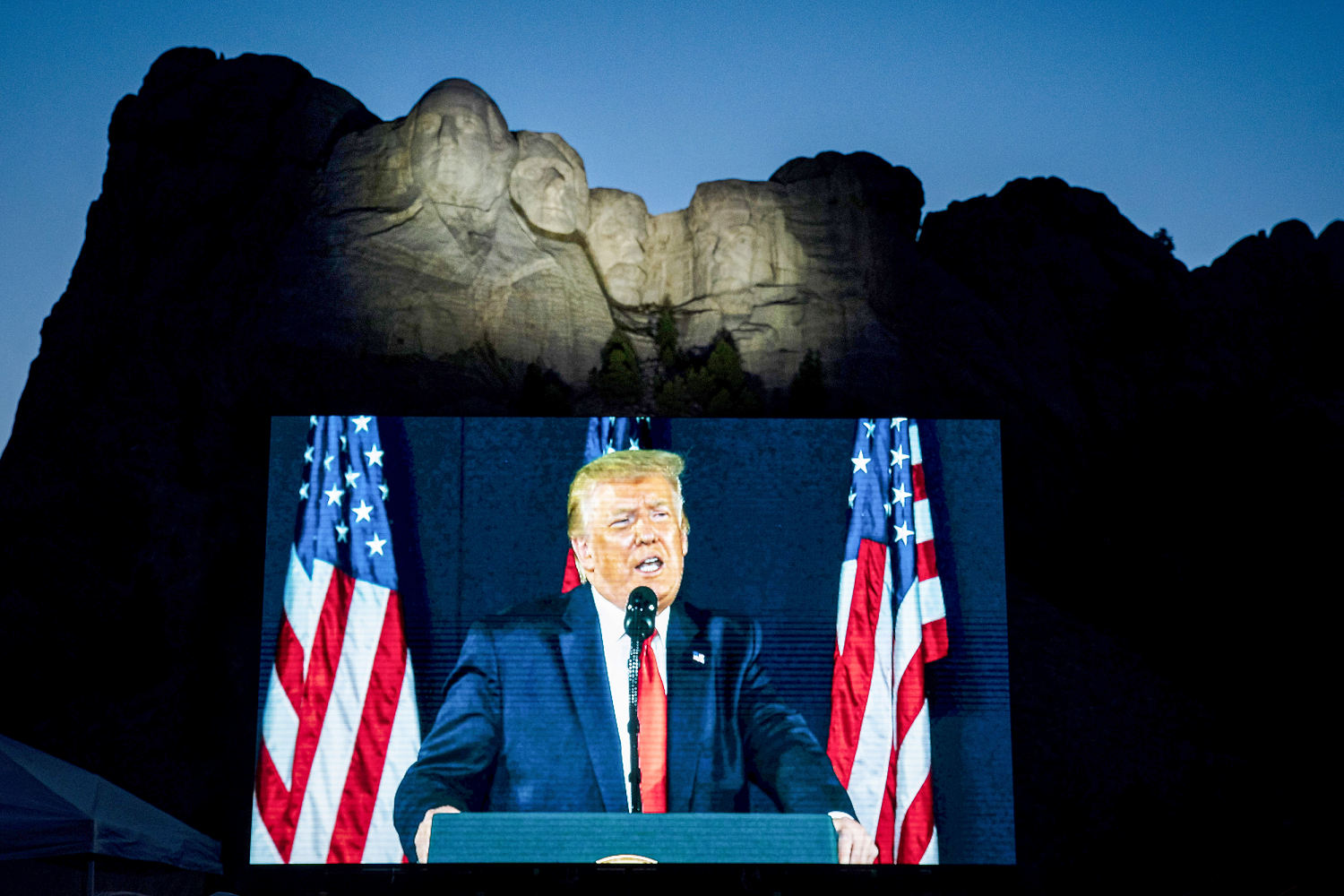
Donald Trump loves monuments, especially when they feature his own name in giant gold letters. He has slapped his brand onto skyscrapers, golf resorts, passports, and even digital coins. Yet, as he returns to South Dakota to speak at Mount Rushmore, he faces a rare, unyielding boundary. No matter how much his allies push, or how many bills get introduced in Congress, the rock simply will not cooperate.
The dream of adding a fifth face to the Black Hills monument has circulated among hardcore supporters for years. Florida Representative Anna Paulina Luna even sponsored legislation to force the issue, and Interior Secretary Doug Burgum dropped hints that there might be space. But when you look at the actual science, the legal battles, and the history behind the stone, you realize the whole campaign is a fantasy. The monument is locked in time, not because of a lack of political will, but because the Earth itself says no.
The Brutal Physics of South Dakota Granite
You can't just take a chisel and some dynamite to a historic mountain without understanding what holds it together. Gutzon Borglum, the original sculptor, spent fourteen years working on the memorial. He didn't just pick a spot out of a hat. He chose the granite cliff because it seemed stable, but even during construction, the rock threw massive tantrums.
When Borglum tried to carve Thomas Jefferson to the left of George Washington, the stone crumbled. The granite was laced with deep, unpredictable fractures. He had to use dynamite to blast Jefferson's partially completed face entirely off the mountain and start over on Washington's right side. That single mistake cost years of work and proved that the rock formation is incredibly volatile.
The National Park Service has spent decades studying the structural integrity of the site. Their engineers use high-tech lasers and sensors to monitor every single crack in the stone. The official verdict remains completely unchanged. The carvable portion of Mount Rushmore is entirely used up. There are no viable locations left for any additional carvings. If a modern crew tried to blast into the remaining rock to shape a new president, the shockwaves could easily destabilize the existing faces. Imagine trying to add a new figure only to watch Abraham Lincoln's nose crack off and plummet into the canyon below.
The Endless Legal Warfare Over Sacred Ground
Even if you found a magic way to stabilize the granite, the legal system provides a massive barrier. Mount Rushmore sits in the Black Hills, an area that holds profound spiritual significance for the Lakota Sioux. The U.S. government signed the Treaty of Fort Laramie in 1868, promising the Lakota that this land would belong to them forever. That promise lasted exactly until gold was discovered in the hills. The government broke the treaty and seized the territory by force.
The legal fallout from that theft hasn't ended. In 1980, the United States Supreme Court ruled that the government had illegally taken the Black Hills. The court ordered a financial settlement, which has ballooned with interest to hundreds of millions of dollars. The Lakota people have consistently refused to take the money. They don't want a payout. They want their sacred land back.
Any attempt by the White House to alter the monument would trigger immediate, massive lawsuits from tribal nations. The administration would have to navigate the National Environmental Policy Act and the National Historic Preservation Act. These laws require lengthy, transparent reviews before anyone can touch a historic site. The courts would tie up any carving proposal for years, if not decades.
The Political Theater of the Black Hills
Politicians don't visit the monument to change the stone. They visit to capture its reflected glory. When Trump stood in front of the monument previously, photographers captured angles where his profile lined up perfectly with the stone giants. It was a brilliant piece of visual staging. His return highlights how the site functions as a powerful backdrop for nationalistic messaging, especially as the country marks major milestones.
South Dakota politicians know exactly how to play into this imagery. Governor Kristi Noem famously gifted Trump a four-foot replica of Mount Rushmore that included his own face. It was a clever political gesture, but it belonged in a trophy room, not on a real mountain.
Other lawmakers want to lock the monument in amber forever. South Dakota Representative Dusty Johnson previously introduced the Mount Rushmore Protection Act. The bill aimed to ban any federal funds from being used to alter, change, or remove any feature of the memorial. Interestingly, the National Park Service actually opposed the bill because they worried the rigid language might restrict their ability to perform daily maintenance and fix natural erosion. The rock requires constant sealing with silicone injections to keep water from freezing inside the cracks and splitting the stone.
The Finished Masterpiece Problem
Artistic history also stands in the way. On October 31, 1941, the federal government officially declared the Mount Rushmore project complete. Borglum had originally intended to carve all four presidents down to their waists, but funding ran out, and the sculptor passed away. His son, Lincoln Borglum, wrapped up the work and walked away.
The site is listed on the National Register of Historic Places. The Department of the Interior has strict preservation standards that focus entirely on maintaining and repairing historic structures. Their rules explicitly discourage making major alterations or adding new elements to completed historic landmarks. Changing the monument would violate the government's own guidelines for preserving American heritage.
Borglum chose the original four presidents to represent specific eras of American development. Washington symbolized the birth of the nation. Jefferson represented expansion. Lincoln stood for preservation, and Theodore Roosevelt represented conservation and global stature. The narrative was set in stone before World War II even began. Trying to insert a modern political figure completely disrupts the historical logic of the design.
How to Separate Political Hype From Reality
When you read headlines about politicians wanting to rewrite American stone, you need a quick way to filter the noise from the facts. Look closely at the actions rather than the rhetoric.
First, check the geological reports. The National Park Service publishes regular updates on the stability of the monument. If the engineers say the rock cannot handle a chisel, no executive order can change the laws of geology.
Second, watch the federal budget. A project of this scale would require hundreds of millions of dollars and explicit appropriations from Congress. Look at the budget bills. If there is no money allocated for engineering studies or tribal consultations, the talk is purely theatrical.
Third, monitor the federal court dockets in South Dakota. Any real move to alter the mountain will start with a wave of emergency injunctions filed by Native American advocacy groups and environmental organizations. If the courts aren't jammed with filings, nothing is actually happening on the ground.
The mountain remains exactly as it was in 1941. The stone faces look out over the valley, indifferent to the shifting political tides below them. Donald Trump can deliver speeches, capture stunning photos, and rally his base at the foot of the monument, but the granite itself will never bear his name.