You probably think of Antarctica as a sterile, frozen desert. Just miles of white ice, blasting winds, and complete isolation. But that picture is wrong. Beneath the blinding white surface lies a complex, thriving ecosystem that scientists are only beginning to decode.
A researcher from the University of Bristol just returned from a gruelling three-month expedition to the frozen continent. What she brought back flips our understanding of polar biology on its head. Far from being a barren wasteland, the Antarctic ice houses "surprisingly rich" and diverse microscopic communities. If you enjoyed this post, you should check out: this related article.
This isn't just a win for biology textbooks. The microscopic organisms living in the ice directly dictate how fast our oceans rise and how our planet handles carbon. If you want to understand where our climate is heading, you have to look at the green, red, and purple sludge growing in the coldest places on Earth.
The Microscopic Forest Hidden in the Ice
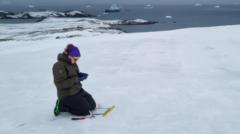
Dr. Arwyn Edwards, a researcher from the University of Bristol, spent three months sampling remote ice caps and coastal glaciers. The goal was simple: find out exactly what lives in the extreme cold. The reality of the fieldwork was anything but simple. It involved drilling into solid ice, enduring sub-zero gales, and hauling heavy gear across shifting glaciers. For another look on this development, refer to the recent update from NBC News.
The payoff was massive. Instead of finding a few hardy, isolated species surviving by a thread, the samples revealed an intricate web of life. The diversity of algae found on this single mission shocked the team.
- Snow Algae: Microscopic single-celled plants that sleep under the winter snow and explode into vibrant green and red blooms when the summer sun hits the slush.
- Glacier Ice Algae: Deeply pigmented purple and brown organisms that live directly inside the hard ice matrix, specially adapted to survive intense ultraviolet radiation.
- Cyanobacteria: Ancient, photosynthetic bacteria that form dark mats, trapping nutrients and creating miniature hot spots of biological activity on the ice.
These aren't random hitchhikers. They are highly specialized residents. They use unique biological antifreeze proteins to keep their cells from bursting when the temperature plummets. They also produce heavy doses of pigments that act as natural sunscreens.
Why the White Continent is Turning Green and Purple
This discovery highlights a massive shift occurring across the polar regions. For a long time, scientists focused their efforts on Arctic algae. The greening of Greenland is well-documented. But Antarctica was thought to be too cold, too isolated, and too harsh for these kinds of widespread, diverse blooms.
That theory is dead.
The Bristol team’s findings build on a growing body of evidence showing that Antarctica is responding rapidly to global temperature shifts. When the summer temperature edges just above freezing, the surface of the ice softens into a slushy brine. This is the perfect breeding ground for microscopic life.
But it takes more than just water to grow a forest, even a microscopic one. It takes food. The research shows these blooms are heavily concentrated near coastal areas and low-lying islands. Why? Because of penguins and seals. Marine wildlife guano acts as a massive nutrient injection, delivering the phosphorus and nitrogen the algae need to skyrocket.
The Albedo Effect and the Melt Loop
This isn't a feel-good story about life finding a way. It’s a warning about feedback loops.
Clean, white snow has a high albedo. It reflects about 80% to 90% of the sun’s energy back into space, keeping the continent cool. But when algae bloom, they change the color of the ice. Suddenly, you have vast tracts of land stained green, dark red, or deep purple.
Darker colors absorb more sunlight.
When the purple pigments in glacier algae absorb solar radiation, they heat up. This heat melts the surrounding ice, creating tiny pockets of liquid water. This water allows more algae to grow, which darkens the ice further, which causes more melting.
Recent climate modeling shows that while these algal blooms currently contribute to a fraction of the total daily melt in Antarctica, the potential for expansion is terrifying. In parts of Greenland, dense algal growth increases surface melt by over 10%. Antarctica is much larger, and as its coastal edges continue to soften, these microscopic communities could turn into major drivers of regional ice loss.
What This Means for Global Carbon Calculations
There’s a double-edged sword at play here. These algae are photosynthetic. They pull carbon dioxide directly out of the atmosphere to build their cells, acting as a regional carbon sink.
Data from satellite mapping reveals thousands of individual algal blooms along the Antarctic Peninsula alone. Combined, these tiny organisms sequester hundreds of tonnes of carbon every single year. That sounds great on paper. But you have to weigh that carbon capture against the loss of the ice sheet.
If the melting accelerates, the rising sea levels will far outweigh the minor benefits of localized carbon sequestration. We can't view these organisms simply as passive residents; they are active players shifting the physical state of the polar ice.
How We Track an Invisible Ecosystem
You can’t manage what you don’t measure. Tracking microscopic life across a continent double the size of Australia is a nightmare. Scientists have to combine old-school boots-on-the-ground sampling with satellite tech.
Field researchers use specialized coring drills to extract ice samples. They analyze the genetic material on-site or ship the frozen cores back to labs in the UK to sequence the DNA. This tells us exactly who is living in the ice.
To find out where they are, researchers use high-resolution satellite imagery. From hundreds of miles up, instruments can pick up the distinct color signatures of green and red snow. By matching the satellite data with physical samples from expeditions like Dr. Edwards’, scientists are building the first comprehensive living map of Antarctic surface biology.
Next Steps for Polar Science
The Bristol expedition proved that our current models are missing a huge piece of the puzzle. We don't fully understand the true scale of Antarctica's biodiversity, and we don't know how fast it's changing.
If you want to track this crisis or support the science, watch the data coming out of the British Antarctic Survey and collaborating universities like Bristol. The next step for the research community is integrating these biological melt factors into global climate prediction models. Until we account for the heat absorbed by billions of microscopic plants, our sea-level rise predictions will remain inaccurate. The ice isn't just melting; it's waking up.