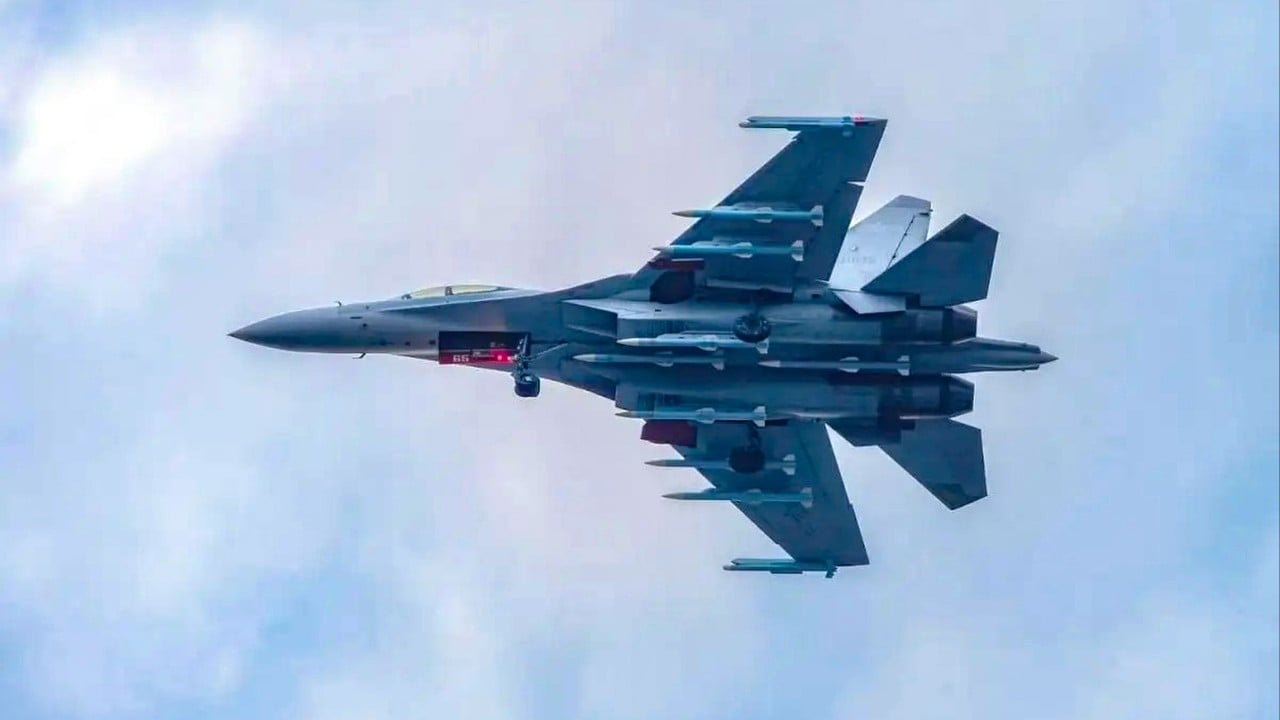
Military observers love to argue about stealth. They obsess over radar cross-sections, internal weapons bays, and the invisible lines of modern air defense. But a series of leaked images and flight data coming out of the Chinese aviation community recently changed the conversation entirely. A People’s Liberation Army Air Force (PLAAF) Shenyang J-16 was spotted flying with a staggering air-to-air loadout: eight PL-15 beyond-visual-range missiles and two PL-10 short-range missiles.
This isn't just a heavy load. It's what western military circles call "beast mode," and it signals a massive shift in how Beijing plans to fight for control of the skies over the Indo-Pacific.
If you look at the standard air patrols China runs near Taiwan or in the South China Sea, you usually see a balanced mix. Maybe two long-range missiles, two short-range ones. Flying with ten live air-to-air missiles creates massive aerodynamic drag and makes the jet light up like a Christmas tree on radar. So why is the PLAAF showing off this heavy configuration now?
The reality is that China is leaning hard into a doctrine built on magazine depth and system-wide networking. They aren't trying to hide the J-16. They're turning it into a flying arsenal.
The Strategy Behind the Heavyweight Missile Truck
To understand why this loadout matters, you have to look past the individual aircraft. The J-16 is a twin-engine, twin-seat strike fighter derived from the Russian Su-30 Flanker family. But don't mistake it for a legacy Soviet jet. Beijing packed it with domestic upgrades: an active electronically scanned array (AESA) radar, composite materials to shed weight, and indigenous WS-10B engines.
When you strap eight PL-15 missiles onto this airframe, you aren't building a dogfighter. You're building a defensive battery with wings.
The PL-15 is arguably the most dangerous air-to-air weapon in China's current inventory. It uses a dual-pulse solid rocket motor that flies at speeds topping Mach 5. What makes it terrifying for opposing pilots is how it manages its energy. The missile fires its initial propulsion stage to climb rapidly and cruise through thin air, conserving energy. Then, during the final intercept phase, the second pulse kicks in. This gives the missile a massive burst of speed right when the target tries to evade, dramatically expanding what planners call the no-escape zone.
Open-source intelligence puts the range of the domestic PL-15 somewhere between 180 and 300 kilometers. By putting eight of these on a single jet, a small formation of J-16s can flood a airspace corridor with high-energy radar-guided threats.
Targeting the Lifelines of Western Air Power
The true objective of a beast mode J-16 isn't to trade blows with nimble American F-35s or F-22s. The real targets sit hundreds of kilometers behind the front lines.
Western air operations in the Pacific rely completely on massive, slow-moving support aircraft. Think of the E-3 Sentry AWACS, the newer E-7 Wedgetail, and KC-135 or KC-46 refueling tankers. Without these flying gas stations and radar hubs, stealth fighters lack the range to operate across the vast distances of the Taiwan Strait or the Philippine Sea. They simply can't stay in the air long enough to secure dominance.
A J-16 carrying eight PL-15s acts as the ultimate counter-infrastructure weapon. It doesn't even need to use its own radar to find these targets. Through high-speed tactical data links, a stealthy J-20 or an airborne early warning platform can spot a US tanker from afar and feed that tracking data directly to the J-16. The J-16 fires its missiles completely silent, keeping its own radar off to minimize detection, while the missiles guide themselves toward the target coordinates before activating their own internal AESA seekers.
If China can force US tankers and command planes to operate an extra 200 kilometers away from the conflict zone, they effectively neutralize the operational effectiveness of short-range western fighters.
The Reality of Aerodynamic Tradeoffs
Every choice in military aviation involves a penalty. You don't just bolt ten heavy missiles onto a plane without paying a price.
First, there is the weight. A fully loaded J-16 suffers from reduced acceleration and reduced maneuverability. If it gets caught in a close-in dogfight, it's at a severe disadvantage until it jettisons those heavy wings store attachments.
Second, the external carriage ruins any minor radar-mitigation features the J-16 airframe possesses. The missiles themselves create multiple reflecting surfaces for modern radar systems.
This means the PLAAF wouldn't use this configuration on day one of a high-intensity conflict against a peer adversary. During the opening hours of a war, stealth and suppression of enemy air defenses take priority. You send in the clean, low-observable platforms like the J-20 to blind the enemy's eyes and knock out their long-range surface-to-air missile batteries.
Once those air defense nets are degraded or pushed back, that's when the J-16 enters the fray in full beast mode. It functions as the cleanup crew, maximizing the number of weapons in the air to overwhelm remaining resistance through sheer volume of fire.
What This Means for Everyday Patrols
We're already seeing how this logic alters the math of peacetime patrols. By demonstrating this capability publicly, the PLAAF sends a clear message to regional neighbors like Taiwan and Japan. They want to show that their magazine capacity can easily match or exceed the standard loadouts carried by Western-supplied forces.
For years, regional air forces could count on a relatively predictable ratio of missiles per Chinese fighter intercepted. That predictability is gone. The sheer volume of weapons changes the risk calculations for fighter pilots intercepting these patrols.
It also highlights China's growing self-reliance in aerospace manufacturing. Mass-producing complex, dual-pulse air-to-air missiles like the PL-15 requires an incredibly sophisticated industrial base. The fact that the PLAAF is comfortable loading their frontline multirole jets to maximum capacity shows their stockpiles are deep enough to support sustained, heavy-payload operations.
Practical Next Steps for Defense Analysts
To keep track of how this trend evolves over the next few months, you need to watch three specific indicators rather than just counting missiles on wings.
Keep a close eye on satellite imagery and spotting data out of China's Eastern and Southern Theater Command bases. Look for whether J-16 units are practicing rapid re-arm cycles with these heavy configurations, which tells you if their ground crews can actually sustain these loadouts during high-tempo operations.
Watch the development of the newer PL-16 missile variant. Analysts indicate this is a thinner, more compressed version of the PL-15 featuring folded fins, designed to let stealth aircraft carry more weapons internally. The interplay between internal stealth storage and massive external carriage will define the next phase of Chinese air doctrine.
Monitor how allied forces adapt their tanker positioning during regional exercises. If US and allied forces start pushing their support infrastructure further back during training runs, it's a direct admission that the J-16's extended reach is already reshaping tactical realities.

_03.jpg)