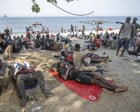
Tens of thousands of people rushed across the Moroccan frontier into the Spanish enclave of Ceuta, transforming quiet coastal streets into an overwhelming humanitarian emergency. Now, the initial chaos of that mass crossing has faded into a grim, exhausting limbo for the Moroccans left behind on the asphalt.
If you look past the breaking news headlines about geopolitical rows between Madrid and Rabat, the human reality on the ground is stark. An estimated 60,000 individuals, mostly young men, made the perilous swim or run around the Tarajal and Benzú breakwaters in late July 2026. Days later, with local facilities operating at thousands of percent over capacity and tens of thousands having already returned or faced expedited expulsions, those remaining are stuck in a legal and physical void.
Understanding the Flashpoint at Europe's African Edge
Why does this tiny territory keep turning into a pressure cooker? Ceuta and its sister enclave Melilla represent the European Union's only land borders on the African continent. That unique geography makes them an inevitable magnet for people seeking a pathway into Europe.
The recent crisis flared up after a volatile mix of social media rumors, smuggling networks capitalizing on legal shifts, and persistent regional tensions. When the frontier controls suddenly slackened, the surge was instantaneous.
Local infrastructure cracked under the weight immediately. Juan Jesús Vivas, the mayor-president of Ceuta, watched local support systems buckle as facilities for unaccompanied minors shot past 2,400% of their normal capacity. Civil Guard officers, National Police, and the Red Cross scrambled day and night to pull exhausted swimmers from the water and treat hypothermia and severe heat exhaustion.
Life on the Streets Post-Crossing
Walking through Ceuta right now doesn't look like a standard European city. Groups of young men sit on curbs, wrapped in foil emergency blankets or donated clothes, staring blankly at their phones or watching patrol cars pass.
They thought they were walking into a gateway to mainland Europe. Instead, they found themselves trapped in a border town smaller than 85,000 residents, completely sealed off by new sea barriers and heavy police cordons.
- The Shelter Shortage: Temporary migrant reception hubs overflowed within hours. Hundreds of adults sleep outside or squeeze into improvised provisional spaces.
- The Volatile Return Rate: While tens of thousands chose or were forced to head back across the border to Morocco within days, a stubborn core remains, refusing to leave despite having no clear legal path forward.
- The Toll on Local Services: Hospitals and municipal workers are stretched to their absolute breaking point, dealing with trauma injuries sustained during the desperate rush across the breakwaters.
The Broader Political Fallout
Madrid and Brussels are pointing fingers while the humanitarian cost mounts. Spain's Prime Minister Pedro Sánchez slammed the influx as a violation of territorial integrity, pointing the finger at human trafficking networks. Meanwhile, right-wing European politicians used the chaos to criticize Spain's broader immigration policies or even question Madrid's place in the Schengen free-movement zone.
At least 72 people lost their lives during the late July incidents, mostly drowning or getting crushed in the frantic stampede along the marine barriers. Behind every single one of those grim statistics is a family back in Morocco or elsewhere in North Africa waiting for news that may never come.
What Happens Next for Those Stuck in Ceuta
The political noise in European capitals won't solve the immediate crisis on Ceuta's pavements. Spanish authorities have prioritized rapid documentation, triage, and expedited expulsions for anyone lacking a legitimate asylum claim.
For the individuals lingering in the enclave's alleys, the choices are narrowing by the hour. Watch the official updates from the Spanish Interior Ministry, monitor legal aid deployment by humanitarian groups active in Andalusia and Ceuta, and look closely at how bilateral agreements between Spain and Morocco shift in the coming weeks to understand the trajectory of this ongoing crisis.