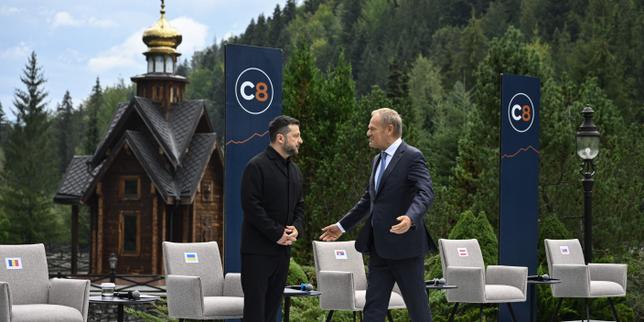
Geopolitics rarely shifts because of a single mountain range, but the newly minted "C8" format is trying to prove everyone wrong. President Volodymyr Zelenskyy just hosted the inaugural summit of the Carpathian countries in the Ivano-Frankivsk region of western Ukraine, bringing together eight nations to lock arms against mounting regional threats.
If you think this is just another diplomatic talk shop, look closer. The stakes are entirely different now. Also making waves recently: Why Mcmaster Is Wrong About Us Uranium And Right About India.
What is the C8 and Why Does It Matter Now
The newly formed C8 brings together Ukraine, Poland, Romania, Slovakia, the Czech Republic, Hungary, Austria, and Serbia. It's a cross-border alliance designed to secure logistics, trade, and regional energy corridors through the Carpathian arc.
For years, regional cooperation formats focused heavily on the Baltic or Black Sea spheres. Kiev realized a massive geographic gap existed right through the center of East-Central Europe. By connecting these eight nations directly, Ukraine isn't just seeking economic lifeline integration with European Union members. It's building a diplomatic firewall. Additional details on this are explored by Associated Press.
Polish Prime Minister Donald Tusk didn't mince words during the opening sessions. He stated clearly that the Russian threat is a collective danger facing every single neighbor in the region. Recent violations of Polish and Romanian airspace by drones, coupled with intensified aerial attacks near NATO's eastern frontiers, made this summit an absolute necessity rather than a polite diplomatic gathering.
The Military Reality Behind the Economic Agenda
While the stated goals of the Carpathian Initiative include cross-border trade, energy security, and robust transport links, you cannot separate trade from defense right now.
Ukraine is currently fighting a brutal war of attrition against escalating drone and missile campaigns. During the summit, discussions immediately pivoted to urgent military needs. Kiev is actively pushing to secure more advanced anti-ballistic missile defense systems and accelerate the development of domestic jet-powered drone interceptors. Moscow has flooded the skies with these fast-moving aerial weapons in recent weeks, forcing frontline democracies to adapt their air defense architectures overnight.
When nations like Poland and Romania face recurring incursions near their borders, the security equation shifts. Border security stops being a localized Ukrainian problem and transforms into an immediate test of alliance resilience.
Navigating Internal Divisions
Building a coalition of eight nations in this specific pocket of Europe isn't easy. You have states like Poland and the Czech Republic pushing for uncompromising military and political support for Kiev, sitting alongside nations with more complicated diplomatic balancing acts, such as Hungary and Serbia.
Yet, the sheer gravitational pull of the war forced leaders to sit at the same table in Ivano-Frankivsk. Zelenskyy summarized the strategic vision best by pointing out how the Carpathian chain should act as a connector rather than a divider.
Security guarantees won't come from declarations alone. They require synchronized infrastructure, shared intelligence on airspace violations, and a unified political will that refuses to let fatigue erode regional solidarity. The C8 is an attempt to institutionalize that unity before the next escalation cycle hits Europe's doorstep.