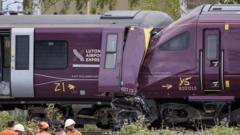
A train slides past a red signal. It keeps moving, slipping down a steep grade on a single-line track, and smashes head-on into an oncoming passenger train. A passenger dies. Dozens are hurt. The easy headline is always the same: "Train driver passed red signal before fatal crash."
But focusing on the driver is lazy journalism. It covers up systemic engineering flaws that actually cause disasters.
The official final report from the Rail Accident Investigation Branch (RAIB) into the October 2024 collision near Talerddig, Powys, reveals exactly what happens when technology handles everything and fails anyway. The 18:31 Shrewsbury to Aberystwyth service overran its stopping point by a staggering 1,080 meters. That is over half a mile of unstoppable sliding.
This was not a case of a driver ignoring a warning. This was a case of a train completely losing its grip on reality.
The Invisible Saboteur Under the Wheel
Railways are fundamentally vulnerable to a simple physics problem: steel rolling on steel requires friction. When autumn leaves fall, they crush under heavy wheels into a black, glassy layer. This coating destroys adhesion.
The RAIB report highlights three interacting failures that made the Talerddig crash inevitable:
- Sanding Failures: Trains rely on automated sanding systems to blast grit under the wheels when slipping occurs. The automatic sander on the lead train failed entirely due to electrical faults in its control circuit.
- Missing Manual Overrides: The driver did not activate the manual emergency sander. On top of that, a roadside traction gel applicator meant to treat the rails was broken.
- The Downhill Slide: Once the train overran the loop, it hit a steep downhill gradient with exceptionally low grip. The brakes stayed locked, but the train kept sliding like a hockey puck on ice.
We expect modern signaling to save us. In this case, the Cambrian line used advanced continuous movement supervision. Ironically, because the system is so heavily automated, engineers reduced the standard physical safety margins. They placed a massive bet on the train's internal sanding systems. When those electronics short-circuited, there was no physical backup left.
Inside the Carriage
What makes the Talerddig report deeply unsettling is how the injuries occurred. We assume the impact force is the sole culprit, but interior design choice plays a dark role.
The passenger who died, David Tudor Evans, suffered fatal injuries because of the specific design of the saloon tables inside the carriage. The tables did not absorb the impact; they weaponized it. The RAIB has now formally recommended a complete rewrite of safety standards for passenger train interiors.
Survivors faced immediate chaos. Internal sliding doors jammed shut, cutting off evacuation paths. Ceiling panels collapsed into the aisles, and equipment cupboards burst open, blocking emergency services from reaching victims quickly.
Fix the Infrastructure Instead of Pointing Fingers
The industry has a habit of trusting software over solid engineering. If a train overruns a loop onto a single track, there should be physical track mechanisms, like trap points, to divert it safely into the ballast rather than allowing a head-on collision.
The RAIB issued nine urgent recommendations following the investigation. To prevent another tragedy, the industry must execute three key actions immediately:
- Redesign Interior Fittings: The Rail Safety and Standards Board must force operators to install impact-absorbing tables and secure interior paneling so it doesn't collapse during a crash.
- Mandatory Sander Diagnostics: Fleet owners like Angel Trains and Transport for Wales must update vehicle software to alert drivers instantly if an automated sanding circuit fails.
- Re-evaluate Risk Assessments: Network Rail must stop assuming that automated signaling eliminates the risk of human or mechanical overruns. Physical infrastructure buffers must return to single-line sections.
Relying entirely on digital control systems while ignoring basic mechanical maintenance creates a false sense of security. Until rail operators treat leaf-film adhesion and interior carriage safety as critical system failures rather than seasonal inconveniences, passengers remain at risk.