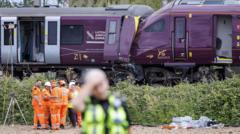
Don't expect your normal commute through Bedfordshire anytime soon. The devastating collision between two East Midlands Railway trains just south of the Elstow interchange has completely paralyzed a critical artery of the UK rail network. While investigators pieces together exactly how the 16:40 Corby service rammed into the back of a stationary Nottingham train on June 19, 2026, passengers face a brutal reality. Rail networks don't just bounce back from an accident of this magnitude. The line between Bedford and Luton will stay completely shut until June 28 at the earliest.
If you think a week of total closure sounds excessive for a cleanup operation, you don't understand the sheer physics and logistical nightmares of a major rail incident. We are talking about clearing shattered multi-ton carriages, managing forensic investigations, and rebuilding obliterated track infrastructure. It is a massive task.
The Reality of the Elstow Rail Recovery
When two trains collide, the damage isn't confined to twisted metal and broken glass. The force traveling through the rails chips concrete sleepers, warps steel lines, and tears down complex overhead power systems. Network Rail engineers cannot simply pull the damaged carriages away with a tow truck.
The process requires highly specialized equipment. Two massive 110-tonne rail-mounted cranes are being brought to the site near Bedford. Setting up these cranes is a logistical feat in itself. They must be safely positioned on stable track, stabilized with outriggers, and operated with extreme care so they don't topple over or cause further structural damage to the embankment.
Clearing the Heavy Armor
The collision involved a brand-new Class 810 Aurora train and a Class 360 unit. One of the rear carriages of the stationary Nottingham train derailed during the impact. Lifting a derailed passenger carriage that weighs dozens of tons requires surgical precision. Engineers have to isolate and remove the overhead line equipment first. If they don't clear those high-voltage wires, the cranes can't operate safely.
Once the overhead lines are down, crews will systematically lift each carriage back onto the rails or onto heavy-haul flatbed vehicles. Every single piece of wreckage must be treated with care because the Rail Accident Investigation Branch needs to examine the physical evidence. Speed takes a back seat to forensic accuracy when a life has been lost.
Rebuilding the Line From Scratch
Once the site is finally clear of the wreckage, the real repair work begins. The impact of a rear-end collision creates intense downward and lateral forces. You can bet hundreds of meters of track will need total replacement.
- Replacing the Sleepers: Concrete sleepers under the rails will have cracked under the sudden stress. They must be dug out and replaced entirely.
- Balancing the Ballast: The crushed stone trackbed gets shifted and contaminated during a crash. Heavy machinery must drop new ballast and tamp it down to ensure absolute stability.
- Rewiring the Overhead Gantry: The power lines that feed these electric and bi-mode trains will need completely new tensioning and wiring across the affected sector.
How to Get Around the Midland Main Line Shutdown
If you usually rely on East Midlands Railway or Thameslink to get into London St Pancras, you need a completely new plan for the week. Do not just turn up at the station hoping for the best. You will end up stranded on a crowded platform.
The Emergency Bus Substitute Reality
Rail replacement buses are operating between Luton and Bedford, but they are a poor substitute for a high-speed train line. A train carriage holds dozens of people comfortably. A bus holds far fewer and has to navigate the local road network, which is already congested due to onlookers and emergency vehicles near the A421 and A6.
Expect your journey time to double, if not triple. If you must travel, aim for off-peak hours to avoid the worst of the crush.
Alternative Rail Routes to Consider
If your journey is absolutely essential, look at alternative lines entirely.
If you are traveling from further north, like Nottingham or Derby, avoid the Midland Main Line completely. Head west toward the West Coast Main Line via Birmingham or East toward the East Coast Main Line via Grantham. It will take longer and cost more, but it beats sitting on a stationary coach in Bedfordshire traffic.
For local commuters south of Luton, Thameslink services are still running into London, but expect heavy crowding as passengers filter in from the bus replacement services.
What the Investigators Are Looking For
The UK rail network prides itself on being incredibly safe. This is the first fatal collision between two passenger trains on a British mainline this century. Because of that, the pressure on the Rail Accident Investigation Branch is immense.
Investigators will focus on the signaling logs and the data recorders on both trains. The Nottingham service had reportedly stopped due to a technical fault on the line. The core question is why the oncoming Corby train didn't stop in time.
Modern British lines utilize the Train Protection & Warning System to prevent exactly this kind of accident. Investigators will check if the system was functioning, whether there was low adhesion on the tracks, or if human error played a part. The answers won't come overnight, and the track cannot open until the initial physical data gathering finishes.
Actionable Next Steps for Commuters
Stop looking at old timetables and start adapting to the situation right now.
- Work From Home If Possible: If your job allows remote work, use it. The line will not open early. Save yourself the stress.
- Double-Check Journey Planners Daily: Apps and national rail websites are lagging behind the fast-changing schedule changes. Check them the night before and right before you leave the house.
- Claim Your Compensation: Keep your tickets. If your journey is delayed by more than 15 or 30 minutes depending on the operator, you are legally entitled to Delay Repay compensation. Record the exact timings of your disrupted trips.