The most famous comic strip of the Middle Ages just crossed the English Channel under armed guard.
Last night, a heavily secured convoy pulled out of Normandy and rolled through the Channel Tunnel. Inside was a custom, climate-controlled container protecting 70 meters of 11th-century linen and wool. By morning, the artifact arrived safely at its destination, the British Museum in London.
This isn't just another standard museum loan. It's a massive deal. For the first time in nearly a thousand years, the artifact documenting the brutal, messy birth of modern England is back on British soil.
If you plan to see it, or if you're just wondering why a giant piece of old fabric is getting a police escort across international borders, here's what's actually happening behind the scenes.
The Reality Behind the Headlines
Let's fix a common misconception immediately. It isn't actually a tapestry.
A real tapestry weaves designs directly into the fabric fabric itself as it's being made on a loom. What arrived in London is an embroidery. Unknown hands stitched colored wool threads onto a plain linen backing after the fabric was already woven.
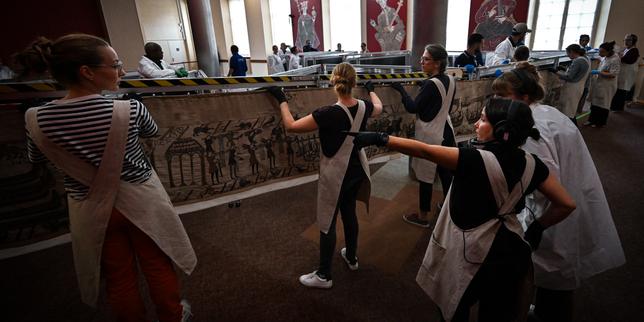
Terminology aside, the logistics of this move are terrifying for conservationists. The piece is nearly a millennium old. It's fragile, susceptible to humidity shifts, and hates vibrations. The French Ministry of Culture and teams from the Bayeux Museum spent months testing the transport protocols. They even used a full-scale replica in April 2025 to simulate the tight turns, bumps, and temperature changes of the journey before risking the real thing.
The artifact left Bayeux on Thursday, July 9, 2026, at 6:15 PM under high security, arriving in London overnight. It's now sitting in the British Museum's secure holding facilities, where experts from both sides of the Channel will spend weeks conducting meticulous condition checks before anyone gets to look at it.
Why the French Lent It and Why Now
The timing works out perfectly due to structural reality. The permanent home of the piece, the Bayeux Tapestry Museum in Normandy, is closing its doors for a major, multi-year renovation. Instead of locking the historic treasure away in a dark, private storage vault for two years while construction crews hammer away, the French government chose to put it to work.
There's plenty of politics involved too. French President Emmanuel Macron and the British government finalized this agreement back in July 2025. It's a heavy-handed piece of cultural diplomacy. Ten years after Brexit, both nations are explicitly using this shared heritage to patch over political fractures and signal a renewed era of cross-channel cooperation.
In return for the loan, British archaeological treasures will head south to be displayed in French museums during the renovation period.
What Makes This Specific London Exhibition Different
If you've already seen the artifact in France, you might think you can skip the London show. You'd be wrong. The British Museum exhibition, which opens on September 10, 2026, and runs until July 11, 2027, changes the display format entirely.
In Normandy, you look at the embroidery mounted vertically in a curved, u-shaped room. It's cramped, and you're constantly shuffling along a track. The British Museum is laying the entire 70-meter length completely flat in a single, continuous, custom-built showcase.
Seeing it flat changes everything. It allows you to appreciate the true scale of the medieval work without the distortion of vertical hanging.
The British Museum is also flanking the display with rare items from its own vaults and European partners to anchor the story. You'll see things like the 1060 charter of Edward the Confessor. That document features the actual signatures and marks of the real-world people stitched into the linen, including King Edward, Harold’s sister Queen Edith, and Earl Harold himself. They're also displaying Junius II, an illustrated manuscript from the Bodleian Libraries that medieval artists likely used as a visual cheat sheet for drawing the ships and clothes on the linen.
The Uncomfortable Irony of the Return
The ultimate irony of this entire event sits right in the historical record. The embroidery tells the story of the Norman Conquest of 1066, culminating in the Battle of Hastings and the death of King Harold. It's essentially a massive piece of pro-Norman propaganda, commissioned by Bishop Odo of Bayeux—William the Conqueror’s half-brother—to justify the bloody invasion of England.
Yet, most historians agree that Anglo-Saxon needleworkers in England, likely around Canterbury, actually made it.
The English embroidered the story of their own catastrophic defeat on orders from their new French occupiers. Now, the descendants of those defeated Anglo-Saxons are paying up to see it at the British Museum.
Your Next Steps for Visiting
Don't expect to just walk up to the British Museum ticket window and get in. Demand is absurdly high.
- Check Ticket Windows: Public tickets officially went on sale on July 1, 2026. The initial batch covers entry dates from September through December 2026.
- Watch for Future Releases: If you missed the first wave, the museum will drop the next block of tickets in October 2026 (for January to March 2027 entry) and a final block in January 2027 (for April to July 2027 entry).
- Book Your Slots Early: Members still need to book advanced, timed entry slots. The exhibition opens to the public on September 10, 2026, and wraps up on July 11, 2027, before the artifact returns to France to be reinstalled in its brand-new museum space in 2028.