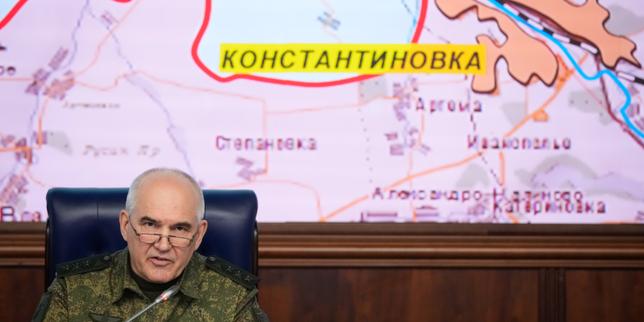
Vladimir Putin just told the world that Russian forces completely captured the strategic city of Kostyantynivka. He even sat down with General Valery Gerasimov on national television to celebrate the victory. There is only one problem with this massive announcement. It is flat-out wrong.
The Ukrainian General Staff immediately shot down the claim. Their forces are still on the ground, still holding defensive lines, and actively hunting down Russian infantry units that managed to slip past the city limits. What we are seeing right now isn't a sudden operational breakthrough. It's a textbook example of cognitive warfare designed to shape headlines over a holiday weekend in the West. Expanding on this theme, you can also read: Why America 250 Belongs To The Immigrants Who Built It.
If you look past the headlines, the reality on the ground tells a completely different story.
The Reality Behind the Fortress Belt Defensive Lines
Kostyantynivka isn't just another dot on the map. It forms the backbone of Ukraine's defensive network in the Donbas, sitting right alongside Sloviansk and Kramatorsk. If Russia actually managed to secure this city, it would open a direct highway toward the rest of the Donetsk region. That's why Moscow is throwing everything it has at this front line. Experts at Al Jazeera have provided expertise on this matter.
But stepping foot inside a city doesn't mean you control it.
According to reports from the frontline, Russian forces have spent months attempting to squeeze the city from the east and west. They've deployed massive numbers of troops, including an entire combined arms army and elements from multiple other naval infantry formations. Despite that massive accumulation of manpower, they haven't won the city. Instead, they've managed to slip small sabotage teams into specific neighborhoods.
Ukrainian military spokesperson Andriy Kovalyov confirmed that tiny infantry groups, sometimes just two or three soldiers, managed to infiltrate deep into the urban center. They ran toward buildings, hid in ruins, and tried to raise flags for quick photo opportunities.
How Fake Flag Videos Shape Western Perception
Moscow needs victories. The entire spring-summer offensive has been an incredibly slow, grinding affair that cost thousands of lives for minimal territorial gains. In fact, data from the Institute for the Study of War reveals that Russian forces captured less than thirty percent of the territory in the first half of 2026 compared to the same period in 2025.
To hide this slowing momentum, the Kremlin relies heavily on information operations.
We saw this play out perfectly on Telegram. The Russian Ministry of Defense flooded social media channels with video clips and photos showing troops raising Russian flags over damaged industrial sites, including the local zinc plant and areas near the central railway station. Military analysts quickly noticed something strange about these videos. Several open-source intelligence groups pointed out that some of these flag-raising clips bore clear signs of digital manipulation or AI generation.
It's a clever trick. You send a tiny group of soldiers to a building on the edge of town, film them holding a flag for thirty seconds before they get targeted by Ukrainian drones, and then broadcast that clip as proof of a "complete capture." For an audience sitting thousands of miles away, it looks like a massive victory. On the ground, it's just a suicide mission for a temporary photo op.
The Cost of Creeping Advances
Let's look at the numbers because they don't lie. The Ukrainian General Staff reported that Russian forces suffered nearly forty thousand casualties in June alone across the entire theater. When you break that down against the actual square kilometers gained, Russia is losing over a thousand soldiers for every single square kilometer they manage to seize or infiltrate.
That is an unsustainable rate of loss, even for a military with vast manpower reserves.
Beyond the human cost, Russia's logistical network is taking a severe beating. Ukraine has aggressively ramped up its intermediate and long-range strike campaigns. By targeting fuel depots, ammo dumps, and transportation nodes in occupied territories and deep inside Russia, Ukrainian forces are starving the frontline units of basic necessities. The loss of fuel transport vehicles skyrocketed this summer, directly impacting how fast Russian armor can move forward.
In Kostyantynivka, this logistical strain means that those Russian units who do manage to infiltrate the city center are often left completely cut off. They don't have heavy armor backing them up. They don't have a steady stream of ammunition. They are interspersed between established Ukrainian defensive positions, creating a messy, fragmented battlefield where the frontline resembles a checkerboard rather than a solid wall.
What Happens Next on the Donbas Front
The fighting inside the city center remains brutal and chaotic. Ukrainian commanders from the 24th and 28th Mechanized Brigades have openly stated that the situation is incredibly difficult. Their logistics are under constant pressure from Russian electronic warfare and drone strikes.
But difficult doesn't mean defeated.
Right now, Ukrainian forces are running counter-sabotage operations inside the urban sectors. They are systematically hunting down the small infiltration groups, clearing out buildings, and maintaining control over the key transit routes that keep their defensive positions supplied.
Expect Moscow to keep pushing this narrative of total victory. They want to convince Western backers that supporting Ukraine is a lost cause and that Russian momentum cannot be stopped. If you want to know what's actually happening, ignore the high-profile television briefings from the Kremlin. Watch the supply lines, watch the casualty rates, and look at the actual maps showing sustainable troop presence rather than fleeting flags in the wind. The battle for the Donbas fortress belt is far from over.


