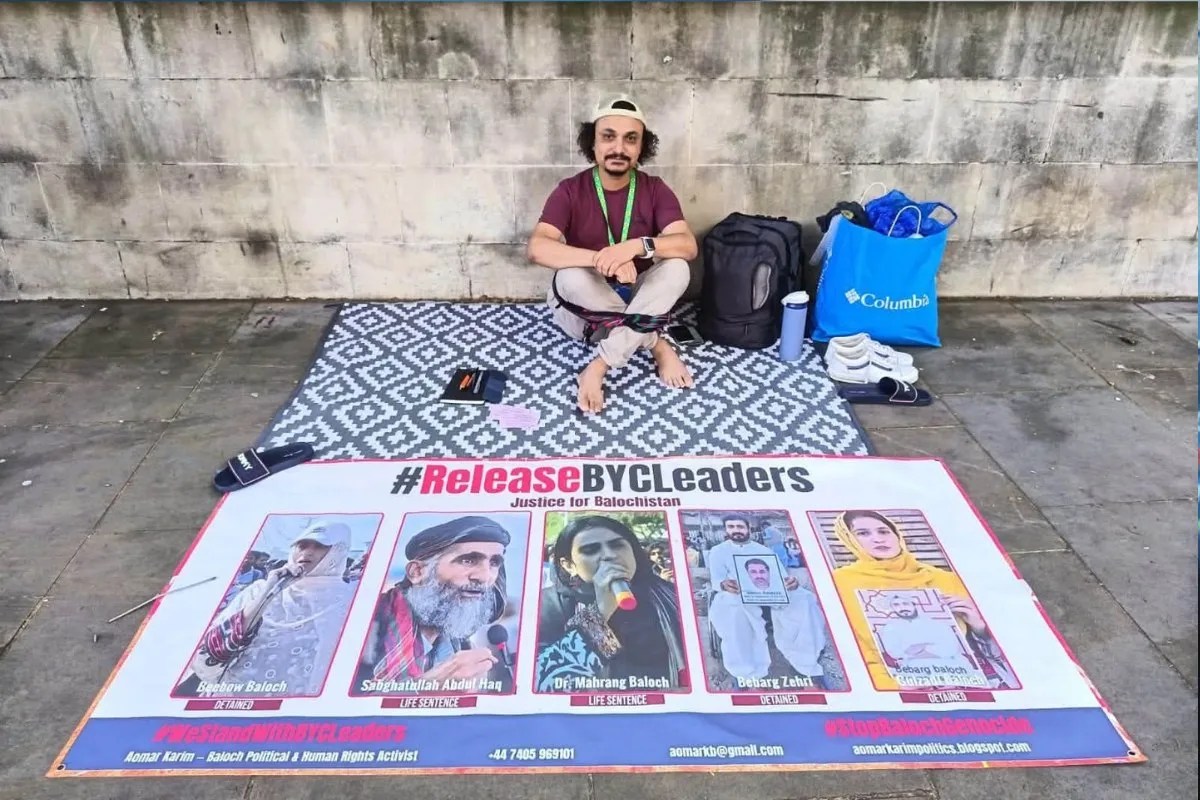
A man sits quietly on a cold London pavement just steps away from the halls of British power. He isn't eating. He won't eat for days. Baloch activist Aomar Karim chose the entrance of 10 Downing Street and the Foreign, Commonwealth and Development Office to make a stand that most global leaders would rather ignore. His demands are straightforward but heavy. He wants the international community to finally look at Pakistan’s brutal campaign of repression in Balochistan.
This isn't an isolated protest. It's a direct response to a massive escalation of political trials inside Pakistan. The immediate trigger for this hunger strike is the recent life imprisonment sentences handed down to prominent Baloch rights leaders Mahrang Baloch and Sibghatullah Shahji. For anyone watching the region, these sentences mark a terrifying shift. The state is no longer just using secret detentions. They're using the courts to permanently silence peaceful dissent. Learn more on a related subject: this related article.
People often ask why activists travel all the way to the UK to protest internal Pakistani matters. The answer is simple. The local avenues for justice in Pakistan are completely broken. When your activists are locked away, your students are abducted from campuses, and your peaceful marchers are met with tear gas, you take the fight to the global stage. Karim's protest is designed to force the British government to choose between its economic ties with Islamabad and its stated commitment to global human rights.
The Spark That Ignited the London Hunger Strike
The situation inside Balochistan has deteriorated rapidly over the last few months. The judicial system handed down life sentences to Mahrang Baloch and Sibghatullah Shahji, two of the most recognizable faces of the Baloch Yakjehti Committee. This committee has mobilized tens of thousands of ordinary citizens, mostly women, to march against state violence. By locking them up forever, the Pakistani establishment sent a clear message. Peaceful activism will be treated with the same severity as armed insurgency. Additional analysis by USA.gov explores similar views on the subject.
Aomar Karim's protest directly targets this legal warfare. He's demanding that the UK government issue an immediate public statement condemning these sentences. He's also highlighting the ongoing, illegal detentions of other activists like Beebow Baloch, Bebarg Zehri, and Gulzadi Baloch. These names rarely make it to mainstream Western news feeds, but they represent the systematic gutting of Baloch civil society.
The strike isn't just about symbolic awareness. Karim is pushing British Members of Parliament, human rights organizations, and international legal bodies to apply direct diplomatic pressure. The UK retains significant diplomatic ties and financial leverage over Pakistan. Activists believe that public condemnation from London could make the military apparatus in Rawalpindi think twice about its next moves.
Decades of Enforced Disappearances and Pain
To understand why a human being would starve themselves on a London street, you have to understand the sheer scale of the horror happening back home. Enforced disappearances have plagued Balochistan for decades. It's a simple, terrifying tactic. Security forces pick up a young student, a journalist, or a doctor. No charges are filed. No court records exist. The family is left in total limbo. They don't know if their loved one is being tortured in a secret cell or buried in an unmarked grave.
Sometimes people come back. They return broken, traumatized, and silent. Often, they don't return at all. Over the years, bodies bearing severe signs of torture have been dumped in desolate areas across the province. This has created an environment of absolute terror. It has destroyed any remaining public trust in state institutions.
The state justifies this by claiming it's fighting a separatist insurgency. But the math doesn't add up. The vast majority of those disappearing aren't guerrilla fighters hiding in the mountains. They are university students from Turbat, human rights lawyers from Quetta, and poetry bloggers. The crackdown targets the intellectual foundation of the Baloch people. By closing down educational institutions like the University of Balochistan and Sardar Bahadur Khan Women's University under the guise of security, the state restricts access to the basic tools of empowerment.
The Double Standard of Western Silence
The British government loves to talk about human rights. Ministers frequently release statements championing global democracy, free speech, and the rule of law. Yet, when it comes to Balochistan, the silence from Whitehall is deafening. This silence is rooted in pure realpolitik. Pakistan is a key strategic partner in South Asia. Western nations rely on Islamabad for regional security intelligence, counter-terrorism operations, and geopolitical balancing acts involving neighboring powers.
This creates a tragic double standard. If these systematic abductions and life sentences for peaceful protesters were happening in an adversarial nation, Western capitals would be shouting for sanctions. Because it's happening in an allied state, it gets swept under the rug.
Activists like Karim are trying to break through this wall of hypocrisy. By bringing the physical reality of a hunger strike directly to the doorstep of British lawmakers, they make the issue impossible to ignore. Every hour that passes with an activist starving outside 10 Downing Street puts a mirror up to the UK's foreign policy values. It forces a public conversation about whether trade and military partnerships should always trump human lives.
What Happens Next for the Baloch Diaspora
Diaspora activism has become the lifeline for the Baloch movement. Inside Pakistan, reporting on these events is virtually banned. Local news channels face immediate censorship if they give airtime to the families of missing persons. Journalists who dare to cover the protests find themselves threatened, arrested, or worse. The responsibility to tell the story falls squarely on the shoulders of those who managed to escape.
London has become a central hub for this resistance. The diaspora here is highly organized, consisting of lawyers, intellectuals, and young activists who understand how to navigate international legal frameworks. They aren't just holding signs. They are compiling dossiers, meeting with sympathetic MPs, and attempting to file cases under universal jurisdiction laws.
The hunger strike concluded with a massive rally outside the FCDO, bringing together students, human rights defenders, and various oppressed communities living in exile. This solidarity is growing. The Baloch struggle is no longer an isolated provincial issue. It's slowly connecting with broader international movements fighting against state-sponsored violence and authoritarian overreach.
The path forward requires sustained, unrelenting pressure. Activists must keep documenting every single disappearance with meticulous detail. They need to bypass traditional diplomatic channels and target international public opinion directly through digital media, university lectures, and high-visibility protests. The British government might try to look away, but the diaspora is ensuring that the screams from Balochistan will continue to echo loudly outside the windows of global power.