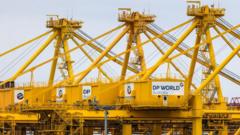
When giant terminal operators look at artificial intelligence, they see streamlined logistics, driverless straddle carriers, and shrinking payrolls. When dock workers look at the exact same tech, they see a direct threat to their livelihood.
The Maritime Union of Australia (MUA) has thrown down a massive gauntlet in its negotiations with DP World. As the Dubai-owned global terminal giant pushes to introduce AI-driven rostering systems, autonomous vehicles, and remote-controlled cranes across its Australian ports, the union isn't just asking for job guarantees. They are demanding a 28-hour workweek with zero loss in pay.
It sounds extreme at first glance. But look beneath the surface, and this dispute reveals the exact conflict every major industry will face as generative tools and autonomous systems roll out.
The Math Behind the 28-Hour Demand
To understand why wharfies are holding out for four seven-hour shifts a week, you have to look at the numbers driving the dispute.
DP World handles roughly 40% of Australia's container maritime freight. In recent terminal proposals, the union estimates that full-scale AI and automated machinery could wipe out up to 1,000 positions—more than 60% of the stevedoring and maintenance workforce across major sites like Sydney, Melbourne, Brisbane, and Fremantle.
The union's logic is pretty straightforward:
- If AI tools and algorithms boost operational efficiency by 30% or 40%, where does that financial dividend go?
- If it all flows to corporate bottom lines, labor loses every single time.
- If that productivity gain is shared, workers can maintain their living standards while spending fewer total hours in high-risk industrial environments.
Instead of fighting technology outright—a battle unions historically lose—the MUA is attempting to tax the productivity of AI using time instead of cash.
Why Port Automation Isn't Just Another Tech Upgrade
Automating a port isn't like deploying a customer service chatbot. Shipping terminals are high-stakes, capital-intensive bottlenecks where a few hours of delay cost millions down the logistics chain.
DP World's plan includes testing machine learning algorithms to manage shift rosters, implementing driverless container transport vehicles, and shifting crane operators from cab seats into distant control rooms.
Port operators argue these systems make terminals safer by removing humans from dangerous zones while keeping cranes running around the clock.
Yet, waterfront unions point out a stark economic paradox. According to reports compiled alongside tax research groups like CICTAR, multinationals operating infrastructure often pay minimal local corporate tax due to complex global corporate structures. When workforce payroll taxes represent the primary economic return a port operator provides to a host nation, slashing 60% of the human staff guts the broader public benefit.
That's why union leaders have rebranded the fight from a basic labor dispute into a sovereign economic issue.
What Most People Get Wrong About Labor vs AI
The conventional narrative around AI workplace disruption focuses almost entirely on tech replacement. Headline writers love the "Robots Are Taking Our Jobs" angle. But the actual friction points on the ground are much more nuanced:
1. Surveillance and Algorithmic Management
Workers aren't only worried about driverless trucks. They're equally concerned about AI scheduling software that tracks every move, optimizes break schedules down to the second, and removes human discretion from team leadership.
2. Timing and Bargaining Tactics
A huge point of friction in the DP World dispute was timing. The union claims the operator waited until after long-term enterprise bargaining agreements were finalized before dropping detailed plans for AI deployment. That move effectively blocked workers from taking legally protected strike action specifically on the topic of technological change.
3. Safety and Override Controls
It’s not just dockers raising red flags. Maritime engineering bodies have repeatedly warned that heavy industrial AI requires mandatory manual overrides and isolated physical kill-switches. When a 40-ton container is moving through the air, software glitches can be fatal.
The Broader Pattern for the Global Workforce
If you think this is isolated to Australian shipping, think again. What’s happening in Sydney and Melbourne terminals is a preview of the next decade of labor relations across tech, transport, manufacturing, and healthcare.
We're shifting from the age of "Will AI take my job?" into "How much of the AI profit do I get?"
We saw early glimpses of this during the Hollywood writers' and actors' strikes, where bargaining centered on AI image rights and automated script generation. We saw it in US port negotiations along the East Coast. Now, the 28-hour workweek demand sets a concrete benchmark for how blue-collar heavy industry might push back.
If automated equipment cuts human labor requirements in half, asking for 28 hours of pay for 28 hours of work—while maintaining living wages—is going to become a standard union playbook worldwide.
What Business Leaders and Workers Should Do Now
Whether you manage an enterprise team or work on an operational floor, watching this dispute offer a few immediate, practical takeaways:
- For Operations Managers: Budget time for labor friction. If you think deploying an automated system is purely a hardware and software project, you're dreaming. Regulatory reviews, safety audits, and union consultations will add months or years to your timeline.
- For Union Representatives: Focus on governance over total bans. Mandating human-in-the-loop oversight, data privacy protections, and shared productivity dividends yields better long-term protection than trying to outlaw software.
- For Policymakers: Sector-specific AI guardrails are inevitable. Relying on voluntary frameworks or general safety institutes leaves critical supply chain infrastructure open to massive economic standoffs.
The 28-hour week demand at DP World isn't a pipe dream or a wild outlier—it's the first real line drawn in the sand over who profits when machines take over the heavy lifting.