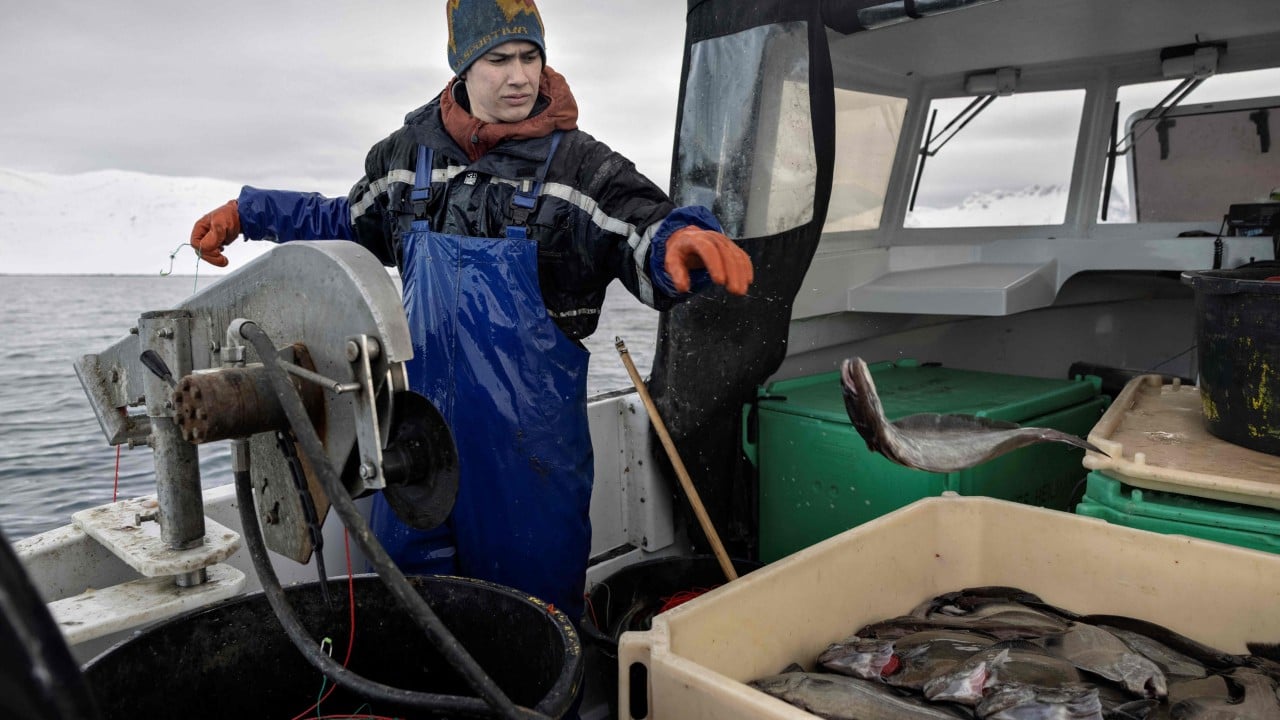
Washington wants Greenland. It doesn't just want the territory for its vast, untapped rare earth minerals or its critical proximity to melting Arctic shipping lanes. It wants its fish. Specifically, the US national security apparatus wants to buy up every single cold-water shrimp and halibut the island can pull out of the North Atlantic, explicitly to starve the Chinese market.
If that sounds absurd, you aren't paying attention to the new reality of economic warfare.
A stark vision emerged from Tom Dans, the head of the US Arctic Research Commission. He suggested the US should buy up Greenland's entire seafood output to cut out the middleman and keep the supply away from China. He joked it could even bring back all-you-can-eat shrimp at Red Lobster. While the casual reference to a casual dining chain sounds funny, the underlying policy isn't a joke. It represents a massive shift in how superpower competition operates.
Securing the Arctic used to mean deploying nuclear submarines under the ice sheets or building early-warning radar arrays like Thule Air Base. Now, national security means weaponizing supply chains down to the very food on global dinner tables.
The Illusion of Purely Military Security
For decades, Western strategists viewed the Arctic through a cold, hard military lens. You counted the hulls of Russian icebreakers. You monitored Chinese research vessels creeping into the Bering Strait. You calculated flight times for intercontinental ballistic missiles over the North Pole.
That framework is officially obsolete.
China calls itself a "near-Arctic state" despite its nearest border sitting thousands of miles away from the Arctic Circle. Beijing isn't trying to invade Nuuk with infantry. They're playing a long commercial game. They purchase stakes in critical mining infrastructure, offer to upgrade regional airports, and buy up massive quantities of North Atlantic seafood.
Greenland's economy is highly vulnerable to this kind of economic statecraft. The territory relies on seafood for roughly 98% of its total goods exports. When a single industry accounts for essentially your entire economic survival, whoever buys your product holds massive political leverage over you.
Washington finally woke up to this vulnerability. The realization hit that if China dominates the purchase of Greenland's primary export, Beijing gains an effective veto over the island's foreign policy. The new US doctrine aims to replace Chinese economic influence with American capital before that leverage hardens.
The Strategy of Preemptive Buying
We're entering the era of defensive monopsony, where a government uses its immense purchasing power to buy up global supply explicitly so an adversary can't have it.
Think about how this plays out on the ground in Nuuk. A local fishing cooperative doesn't care about the grand geopolitical chess match between Washington and Beijing. They care about price, reliability, and market access. If Chinese buyers offer premium rates for cold-water shrimp, the cooperative sells to China.
To break this link, the US can't just tell Greenland to stop selling to the Chinese market. That approach alienates a crucial North American partner. Instead, Washington has to match or beat the offer. The US must become the buyer of first and last resort.
- Economic insulation: By absorbing Greenland's seafood exports, the US provides the island with financial security, removing the temptation to accept Chinese infrastructure loans.
- Denial of resources: It denies China easy access to premium, high-protein food supplies as Beijing struggles with its own domestic food security and agricultural challenges.
- Geopolitical alignment: It binds Greenland tightly into the North American economic orbit, solidifying the 1951 defense agreement with Denmark through daily commercial trade.
This isn't free-market capitalism. It's aggressive state capitalism deployed by the West to counter aggressive state capitalism from the East.
Minerals and Marine Life Share the Same Sandbox
You can't separate the seafood trade from the race for critical minerals. Greenland holds massive deposits of rare earth elements, iron ore, zinc, and gold. The Kvanefjeld mine project, which contains immense rare earth resources, has already seen significant investment interest from Chinese entities like Shenghe Resources.
Developing these mines requires billions of dollars in infrastructure, roads, deep-water ports, and energy grids. Greenland doesn't have the spare capital to build this out on its own. If the local economy struggles because its traditional fishing markets face geopolitical turbulence, the pressure to accept Chinese capital to open up these mines becomes irresistible.
By stabilizing and dominating the seafood sector, the US builds a protective wall around Greenland's mining future. It keeps the local government financially stable enough to wait for Western or European consortiums to develop the mineral resources responsibly, rather than rushing into the arms of Chinese state-backed enterprises.
Why the Atlantic Ocean is the New Economic Frontline
Many people get the Arctic scramble wrong. They assume the threat is a sudden deployment of Chinese warships off the coast of Greenland. The real tension is far more subtle. It takes place in shipping logs, trade data, and corporate boardrooms.
The European Union recognized this dynamic too. They opened a permanent office in Nuuk and signed a memorandum of understanding to develop sustainable raw material value chains. The West is finally coordinating a unified economic defense, realizing that leaving Greenland isolated makes it a prime target for adversarial economic coercion.
Using seafood as a national security tool shows just how blurry the line between trade and warfare has become. When a simple plate of fish turns into a strategic asset, no industry is neutral anymore. The US isn't just defending a frozen landmass; it's aggressively walling off the western hemisphere's supply chains from any external footprints.
Your Next Strategic Steps
If you operate in global trade, supply chain management, or defense policy, you need to adapt immediately to this highly securitized trade environment.
- Map Your Adversary Exposure: Audit your supply chains to identify any secondary dependencies on regions facing intense superpower competition, particularly the Arctic and Nordic zones.
- Anticipate State Interventions: Expect Western governments to introduce more aggressive purchasing subsidies, tariffs, and trade restrictions on non-traditional sectors like agriculture, fisheries, and low-tech logistics.
- Align with Transatlantic Frameworks: Pivot your long-term procurement strategies to leverage the growing economic integration between the US, the EU, and Arctic territories, ensuring your operations sit safely inside the newly constructed Western economic fortress.


