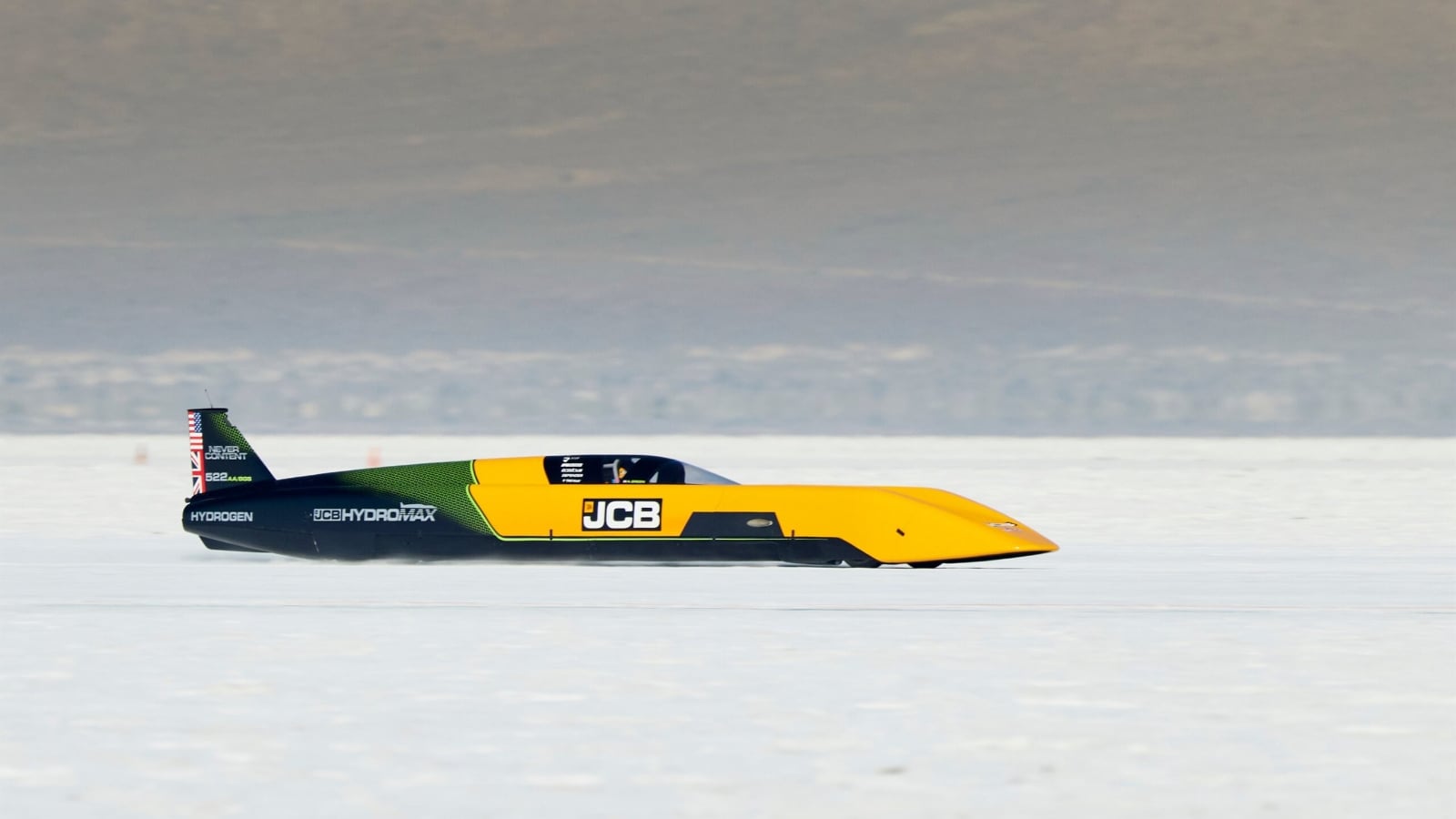
Two decades after shaking up the record books with an oil-burning streamliner, retired Royal Air Force fighter pilot Andy Green is back on top. He just drove a 32-foot rocket ship called the JCB Hydromax to a staggering 406.320 mph average on the Bonneville Salt Flats.
Forget what you think you know about alternative fuels moving slowly. This wasn't a sleek battery-electric cruiser. It was a twin-engine, hydrogen-combustion beast pushing 1,600 horsepower across the blinding white crust of Utah. If you want to understand where combustion tech might survive in a zero-emission future, look right at what happened on the salt.
How the Hydromax Shattered the Ceiling
The engineering behind this record is honestly wild. Instead of building an exotic race engine from scratch, British manufacturer JCB ripped open their playbook for heavy machinery. They took the exact same four-cylinder, 4.8-liter hydrogen units they put into everyday diggers back home in Derbyshire, England, and handed them over to Prodrive and Ricardo to get thoroughly reworked.
You get two engines hard-mounted to a tubular chassis—one dedicated to the front axle and one to the rear. Each unit revs past 4,000 rpm, churning out ten times the power of a standard construction vehicle. When you strap yourself into a carbon composite cell between a pair of forced-induction hydrogen monsters, you don't just feel the acceleration. You feel the massive vibration of a fuel type that skeptics claimed could never produce real motorsport performance.
The Fédération Internationale de l'Automobile (FIA) rules are brutal. To lock in an official World Flying Land Speed Record, the team couldn't just make one fast pass. They had to complete two runs in opposite directions across a 10-mile course within a strict 60-minute window.
During that frantic hour on the salt, Prodrive mechanics had to swivel the car around on a trailer because the steering lock is minimal, swap out custom aerospace Goodyear tires, and pump fresh hydrogen from a haul truck. They did it in just 50 minutes. Green hit 400.623 mph on his first pass and screamed back at 412.135 mph on the return, producing a final two-way average of 406.320 mph.
Beating the Ghosts of 2006
Most petrolheads remember when Green piloted the JCB Dieselmax to 350.092 mph back in 2006. That record proved diesel wasn't just for sluggish farm tractors. Twenty years later, JCB wanted to make the exact same statement about hydrogen internal combustion.
Before this run, the official FIA land speed record for a hydrogen internal combustion vehicle sat at a measly 185.5 mph, set by a BMW research prototype way back in 2004. Even university-built hydrogen fuel cell cars topped out near 302 mph. Green didn't just break the old combustion record; he utterly destroyed it, going more than twice as fast while proving that internal combustion can run cleanly on hydrogen without tossing fossil fuels into the mix.
Of course, the salt flats don't care about your marketing pitch. The Bonneville crust behaves like packed snow—surprisingly slick and deeply unforgiving. Green, who turned 64 right before the attempt and famously remains the only person to break the sound barrier in a car (hitting 763 mph in the Thrust SSC jet back in 1997), knew the risks. He drove with total precision, deploying his self-packed parachute around mile seven to bring the massive streamliner to a halt.
What This Means for the Future of Heavy Industry
Let's be real. Passenger cars are rapidly shifting toward batteries, but heavy equipment, construction fleets, and long-haul transport face a totally different set of physics. Batteries are heavy, take forever to charge in remote work sites, and struggle under constant high-load operations.
JCB chairman Lord Bamford isn't building toys. His company manufactures earthmovers that need to run ten hours a day in muddy fields where plug-in infrastructure simply doesn't exist. By proving that standard production-based engines can burn green hydrogen reliably at extreme output levels, this 406 mph run serves as a massive proof of concept.
Hydrogen is only as clean as how you make it, and sourcing truly green hydrogen remains an uphill battle globally. Yet, the mechanical viability of burning it cleanly is no longer a theoretical debate.
If a modified digger engine can push past 400 miles per hour on a salt flat, the technology has graduated from the lab. Expect to see hydrogen combustion quietly creeping into heavy industries while everyone else is still arguing about passenger sedans.