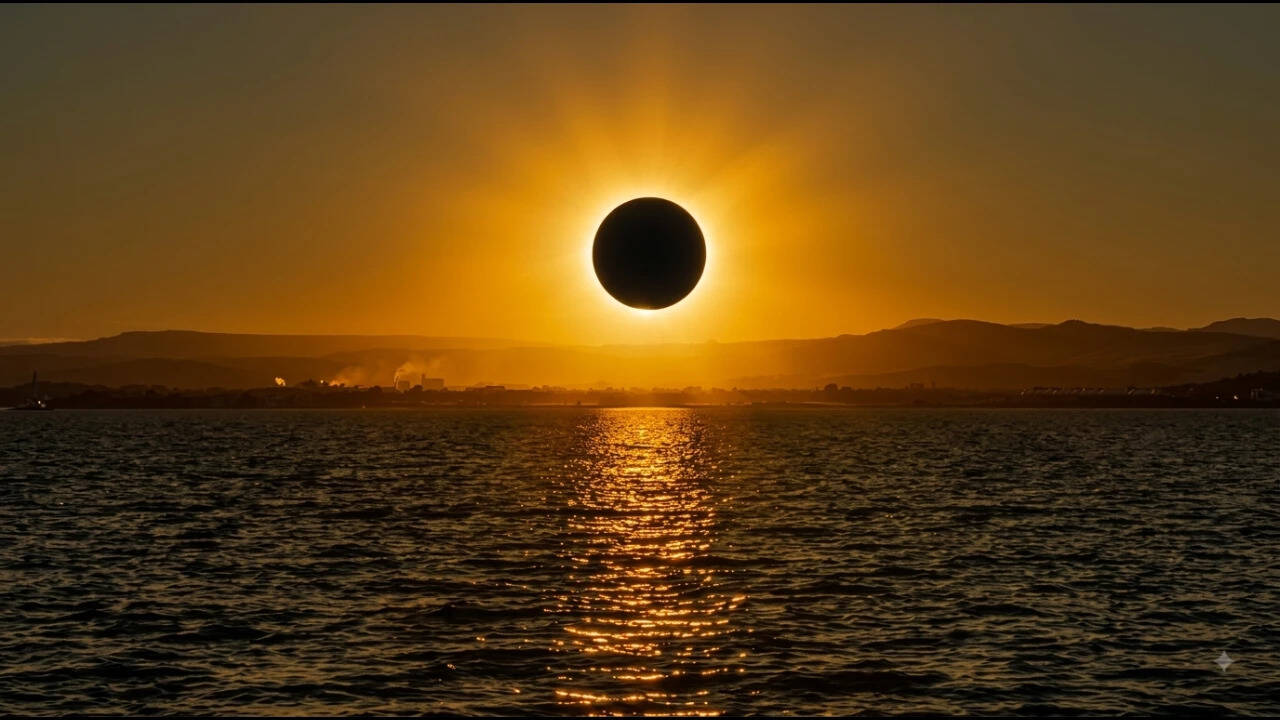
If you are expecting the sky to plunge into eerie, midday darkness across the United States today, you are in for a disappointment. The total solar eclipse happening on August 12, 2026, is a massive global astronomical event, but it's bypassing mainland America's path of totality completely.
Europe is taking center stage for this one. Mainland Europe is getting its first total solar eclipse in twenty-seven years, with the Moon's shadow carving a dark path straight across Greenland, Iceland, northern Spain, and a sliver of Portugal.
So, what do you actually get if you are watching from the US? A partial view, a subtle dimming of daylight, and a great excuse to tune into a livestream. Let's look at what's happening and where you can catch a glimpse.
Where the Shadow Actually Goes
The core of the Moon's shadow—known as the umbra—won't touch the lower forty-eight states. Instead, the cosmic show starts way up north in Siberia, tracks across the Arctic, plunges down over Greenland and Iceland, and then sweeps across Spain right before sunset. People standing in towns like Reykjavík or Valencia will watch day turn to night for a couple of minutes.
It is a rare geometric alignment. The next big total solar eclipse won't cross North America like the one we saw back in April 2024. This one belongs to the Eastern Hemisphere and the North Atlantic.
Can Americans See Anything at All?
Yes, but you need to temper your expectations. While the US misses totality entirely, parts of the country sit inside the penumbra, which is the fuzzy outer part of the Moon's shadow.
Alaska and twenty-six states across the northern US and parts of the East Coast will catch a partial eclipse. Canada gets a slightly better deal, with eastern provinces like Newfoundland seeing over half the Sun covered.
Here is what visibility looks like depending on where you are standing:
- Fairbanks, Alaska: Roughly 37 percent of the Sun gets blocked, making it the deepest partial eclipse visible in the US.
- Bangor, Maine: About 24 percent coverage.
- New York City: A meager 9 percent nip out of the solar disk.
- Detroit, Michigan: Just 3 percent coverage.
If you live south or west of these regions, you won't notice a thing outside of normal weather patterns. The light won't fade, and birds won't get confused about bedtime.
Why NASA Urges You to Watch Anyway
NASA is pushing hard to get people excited about today's eclipse, even if your local view is underwhelming. That is because technological tools and broadcasts make it easy to experience totality in Iceland or Spain from your living room desk.
Official livestreams start early afternoon EDT. You can stream high-definition telescope feeds directly from European observatories and research aircraft flying straight through the stratosphere. It beats staring at a 3 percent partial view in Detroit where you can barely tell the Moon is doing anything.
Safety Rules for the Partial Zone
If you are in Alaska, Maine, or anywhere else experiencing a partial phase today, do not stare directly at the sky without protection. Regular sunglasses are completely useless here.
You need certified solar viewing glasses built to strict international safety standards. The Sun remains dangerously bright during a partial eclipse because the Moon never fully blocks it. If you use binoculars or a camera lens, attach a specialized solar filter to the front element immediately or risk permanent eye damage.
Grab your certified shades if you live up north, or pull up a NASA feed on your screen and watch Europe turn dark.