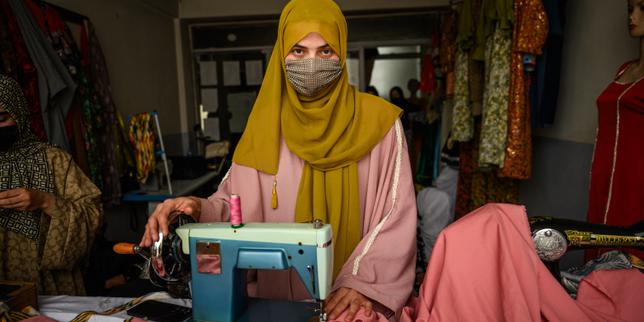
When the state shuts every door, you build a window. That is the reality for thousands of Afghan women today. They aren't waiting for permission to exist. They are opening small businesses in their kitchens, their living rooms, and whatever hidden spaces remain accessible to them.
It’s easy to look at the news from Afghanistan and see only a country sliding backward. The headlines focus on the bans—the closed universities, the shuttered government offices, the erasure of women from public view. But if you talk to the women on the ground, you see a different story. You see defiance. They are running workshops, selling handmade soap, weaving carpets, and trading goods. It’s not just about money. It’s their quiet, relentless way of fighting back.
The Business Paradox
You might find it strange to hear about a boom in female-led businesses in a place where women can barely leave their homes. The numbers don't lie, though. The Afghanistan Chamber of Commerce and Industry recently reported that more than 10,000 women now hold formal business licenses. That is roughly ten times the number seen just five years ago.
This isn't a sign of progress in the traditional sense. It’s a survival mechanism. Many of the women who once dreamed of becoming lawyers, engineers, or civil servants have had those career paths burned to the ground. When the government effectively banned them from the professional sphere, they were left with a stark choice: starve or adapt. Entrepreneurship became the last remaining path to agency.
The United Nations Development Programme notes that small businesses are now the single largest employer of Afghan women. It’s a messy, difficult, and high-risk economic reality. These women face constant threats. They deal with restrictions on traveling, hurdles in dealing with male suppliers, and a banking system that is increasingly difficult for them to navigate independently.
Beyond the Licenses
The 10,000 formal licenses are just the tip of the iceberg. Experts estimate that over 100,000 other women are operating informal trades. These are the operations you don’t see in official reports. They are the neighborhood networks where women trade services and goods to keep their families fed.
Why does this matter? Because it challenges the narrative of total victimhood. Yes, the systemic erasure of women’s rights is real and it is brutal. More than 260 decrees have been issued by the current authorities to strip women of their humanity, their freedom of movement, and their legal protections. Yet, in the face of this, the economic participation of women has actually shifted in scale.
They are doing it because they have no choice. They are doing it because the world has largely failed to create a cost for the exclusion of women. So, they decided to be the ones to maintain their own livelihoods.
The True Cost of Exclusion
We need to talk about the long-term damage here. While these individual acts of entrepreneurship are heroic, they cannot replace the institutional loss of an entire generation of professionals.
UNICEF projects that by 2030, Afghanistan will lose at least 25,000 female teachers and healthcare workers. This isn't just a number. It’s a collapse of the essential services that keep a society running. When female doctors, nurses, and midwives are pushed out of the workforce, maternal mortality rises. When female teachers are banned, the next generation loses the ability to learn.
This creates a vacuum that is impossible to fill. The current system is essentially cannibalizing its own future. The loss of educated women is costing the country tens of millions of dollars in economic output every single year. It’s a self-inflicted wound that gets deeper every day.
Practical Realities of Staying Afloat
If you want to understand how these women function, look at the logistics. They’ve had to invent entirely new ways of working. Since they often cannot travel without a guardian, they rely on complex courier networks or neighbors to move their goods. They use word-of-mouth rather than digital marketing, which is safer given the surveillance of their online activities.
They are essentially running an underground economy. They are experts at navigating risk, managing micro-supply chains, and finding ways to generate income that don't alert the authorities. This requires a level of grit that is difficult to overstate. It’s not a business model you’d learn in school; it’s one born from necessity.
Why This Fight Needs Attention
Most people think these women need "help." While resources are always in short supply, what they really need is recognition of their autonomy. Their struggle is the only thing standing between them and total invisibility.
Supporting these local efforts is tricky, but it’s the only way to ensure that the economic engine of the household survives. When you look at the landscape of 2026, don't just see the bans. See the women who are working in the margins. They are proving that even when the state tries to erase you, your ambition can still find a way to breathe.
If there is any hope for the future of Afghanistan, it lies in these small, defiant acts of commerce. It isn't a substitute for rights, education, or justice. But it is a way to stay alive until the tide eventually turns.
These women aren't waiting for the world to notice. They are already working. Their survival is their own business.