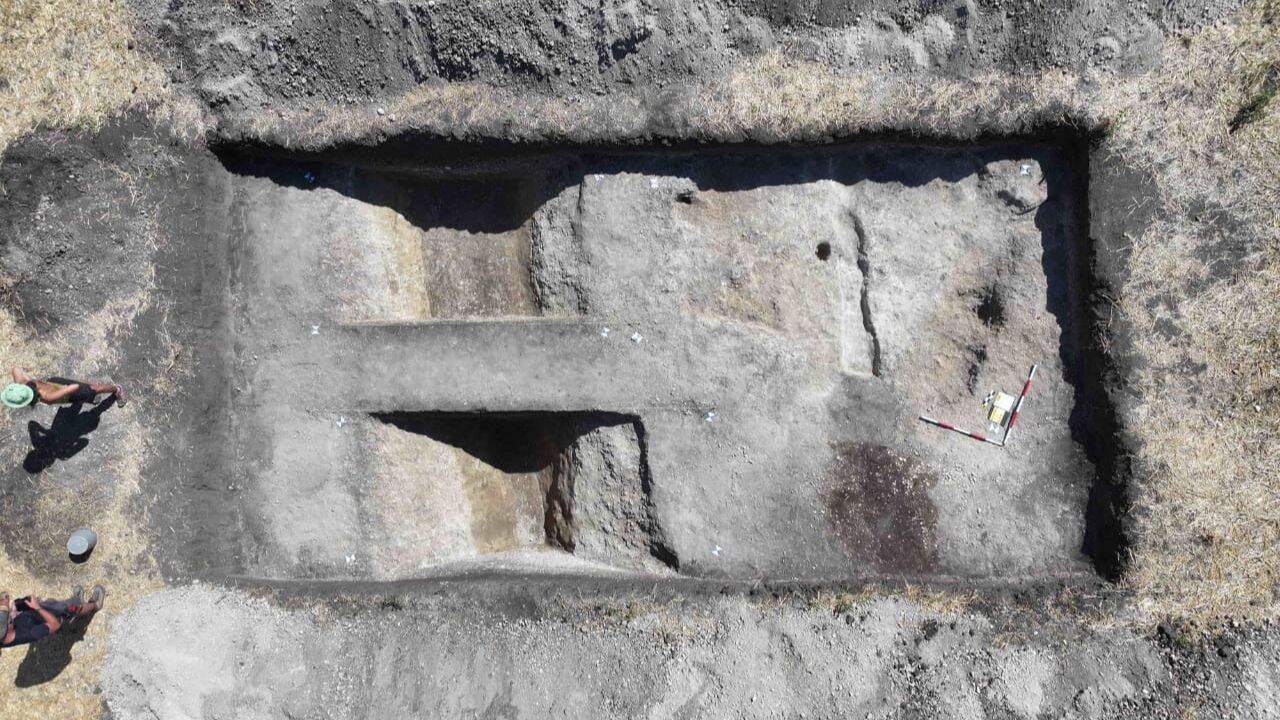
Stonehenge usually gets all the credit for ancient sky-watching, but it's actually late to the party. Archaeologists working near the village of Chleby in the Czech Republic have uncovered a massive prehistoric sanctuary that blows past the famous British stone circle by more than a thousand years. Built roughly 6,500 years ago during the Neolithic period, this circular enclosure proves that early European farmers were tracking complex solar and lunar cycles long before anyone hauled a sarsen stone into place on Salisbury Plain.
If you think ancient humans were just trying to survive day-to-day without looking up, this site changes the narrative completely. Led by researchers from the University of West Bohemia and collaborating experts like Jan Turek from Charles University, excavations at Chleby reveal an advanced architectural space where landscape, ritual, and astronomy collided.
Decoding the Chleby Enclosure
The scale of the monument is hard to ignore. It spans an impressive 230 meters in diameter, carved into the Bohemian earth as a nearly circular ditch deeper than 2.5 meters. What makes it truly strange are the 12 entrances breaking its perimeter. At first glance, an irregular gap pattern looks random.
It isn't. Petr Krištuf and his archaeological team mapped the geometry of those openings and found a precise system. The entry points were deliberately angled to frame specific celestial milestones.
- The Solar Axis: Certain gaps align directly with sunrise during the summer solstice and sunset during the winter solstice.
- The Lunar Cycle: Other alignments track the Moon's extreme northern and southern positions on the horizon across its roughly 18-year cycle.
This setup mirrors the functional logic later seen at Stonehenge, but built over a millennium earlier. These early farmers weren't just guessing when to plant crops. They were embedding a physical calendar into the geography of their community.
Rituals at the Gateway
Monuments of this size never served purely practical functions. People didn't dig a 230-meter ditch just to keep track of planting season. Excavations inside the perimeter ditches have uncovered animal remains, specifically bull skulls and horns, concentrated near the entry points.
Archaeologists suggest these cattle horns decorated massive wooden gateways. Walking into the sanctuary meant passing under the gaze of sacred animal symbols. In early farming societies across Europe, cattle held immense religious and economic weight.
Human presence lingered here for generations, too. Later layers revealed a Bronze Age burial site associated with the Únětice culture, where roughly 18 individuals were interred over a long period. Even as the exact architectural purpose shifted, the landscape retained its sacred gravity. By the Iron Age, parts of the ditch had transformed into water management dikes, eventually giving way to ordinary residential settlements. The sanctuary faded into dirt, houses, and modern fields.
Why This Discovery Matters Now
We often look at prehistory through a lens of technological lack. We assume that without metal tools, digital tracking, or written records, ancient people lived entirely in the dark about the mechanics of the universe.
Chleby shatters that assumption. It demonstrates that Neolithic communities possessed a sophisticated spatial awareness and a desire to connect their daily existence directly to the cosmos. They didn't need modern instruments to map an 18-year lunar cycle. They needed patience, generational memory, and an intimate relationship with their horizon.
Next time someone claims Stonehenge is the ultimate ancient observatory, remember the farmers of Central Europe who beat them to it by a thousand years.