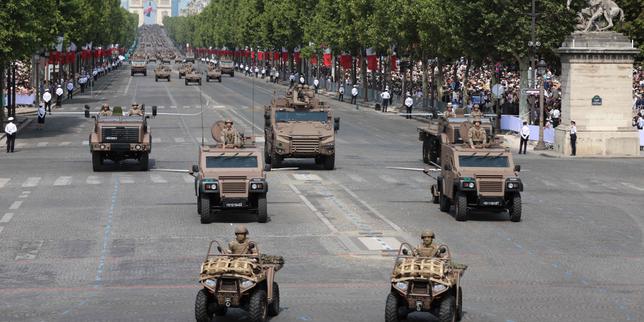
The traditional July 14 military display down the Avenue des Champs-Élysées is usually a well-choreographed exercise in national pride. You see the Republican Guard, the heavy tanks, and the Alpha Jets of the Patrouille de France painting the sky in blue, white, and red. But the 2026 edition wasn't a standard celebration of French history. It felt like a massive, physical warning shot aimed directly at Moscow.
If you watched the broad, surface-level television coverage, you saw French President Emmanuel Macron and Ukrainian President Volodymyr Zelensky sharing an emotional embrace in the presidential grandstand. You saw 25 battle-hardened Ukrainian soldiers walking down the cobblestones, receiving a thunderous ovation from 50,000 spectators. But the real story lies in what this parade explicitly signals about the changing strategic reality of the continent.
Europe is moving past mere financial aid package announcements. It's actively building a combined fighting force that functions completely independently of Washington.
The Coalition of Volontaires Takes Center Stage
For the first time ever, a contingent of nearly 500 troops representing 35 different nations led the ground march. This isn't a NATO operation. This is the Coalition of Volontaires, a European-led security alliance explicitly built to support Kyiv and shield the eastern flank from long-term Russian aggression.
Seeing British Prime Minister Keir Starmer, German Chancellor Friedrich Merz, and Polish Prime Minister Donald Tusk standing together in the VIP stands wasn't just a photo op. It underscored a profound shift. The day before the parade, these leaders held an emergency summit in Paris. They finalized an agreement to sustain long-term military assistance, and crucially, discussed deploying European boots on the ground to enforce a future ceasefire line once the active hot phase of the war cools down.
Coalition of Volontaires Core Metrics (July 2026)
- Participating Nations: 35 European states
- Troops in Ground Parade: ~500 soldiers
- Total Event Spectators: 50,000+ required to pass QR security checks
Honestly, the message couldn't be clearer. With Donald Trump back in the White House and American foreign policy looking highly unpredictable, Europe is forcing itself to grow up. General Fabien Mandon, the French Chief of the Defense Staff, didn't mince words, calling the joint parade the "physical incarnation of strategic solidarity".
High Skies and Joint Cockpits
The most striking moment of the day happened hundreds of feet above the Arc de Triomphe. Right behind the Patrouille de France, two Dassault Mirage 2000-5F fighter jets roared through the low clouds on an east-west axis toward the Louvre.
One plane was painted entirely in the bright yellow and blue of the Ukrainian flag. The other bore traditional French Air Force markings. Inside those cockpits, French and Ukrainian pilots sat side-by-side, flying in a tight, hyper-coordinated formation.
This wasn't just a symbolic gesture for the cameras. It was a loud demonstration of operational integration. Ukrainian pilots are no longer just trainees working at hidden bases in western France; they are now fully integrated peers flying frontline European hardware over Western capitals.
Macron's Strategic Legacy Choice
This marks Emmanuel Macron's ninth and final Bastille Day parade as president, and he clearly intended it to serve as a strategic testament. Over the last four years, his administration faced intense criticism for moving too slowly on heavy weapons deliveries to Ukraine. By putting the war front and center during France's most sacred national holiday, he's cementing a very specific legacy. He wants to be remembered as the leader who shook Europe out of its defensive complacency.
The presence of the 25 Ukrainian combat veterans—men who have been fighting Vladimir Putin's full-scale invasion for over four years—drove that point home brutally. They didn't wear immaculate parade uniforms. They marched in faded, functional field treillis, bringing the raw reality of the Donbas trenches directly to the paved luxury of Paris.
Critics will say that a parade doesn't win a war of attrition, and they're right. Russia still holds massive artillery advantages along the frontline. But what happened on the Champs-Élysées proves that the political will to abandon Ukraine simply isn't there among the continental powers. Europe is building a wall, and France is demanding to hold the bricks.
Actionable Takeaways for Following the Strategic Shift
To truly understand where European defense goes from here, stop watching the ceremonial speeches and monitor these three specific indicators over the coming months:
- Joint Procurement Programs: Watch whether the 35 nations in the Coalition of Volontaires transition from sending spare stockpiles to placing massive, unified industrial orders for French Rafale jets, German Leopard tanks, and air defense systems.
- The Evian Accord Funding: Keep an eye on how quickly the financial pledges made during the recent G7 meeting in Evian are converted into immediate drone and electronic warfare shipments for the Ukrainian armed forces.
- Ceasefire Deployment Frameworks: Track the diplomatic working groups currently mapping out exactly how a joint European volunteer force would be structured to act as peacekeepers on Ukrainian soil if a frozen conflict scenario emerges.