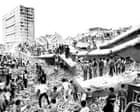
Diego Maradona lifting the World Cup trophy at the Estadio Azteca is one of the most iconic images in football history. But that moment almost never happened. Nine months before the tournament kicked off, a massive magnitude 8.0 earthquake tore through Mexico City. It left at least 5,000 people dead—though some estimates put the true toll closer to 40,000—and turned entire neighborhoods into war zones.
With much of the capital flattened, the global community expected the tournament to be cancelled or moved. Instead, Mexico pushed forward. Looking back at it today, the story of 1986 isn't just about sporting triumph. It's a raw lesson in political defiance, questionable priorities, and the sheer resilience of a nation under pressure. Learn more on a connected topic: this related article.
The disaster that changed everything
On September 19, 1985, at 7:17 AM, the ground beneath Mexico City shook for more than two minutes. The energy released was devastating, amplified by the fact that the capital sits on an ancient lakebed with soft soil. Buildings between 6 and 15 stories tall resonated with the seismic waves and collapsed like houses of cards.
Hospitals, schools, churches, and apartment complexes caved in. Over 30,000 people lost their homes in an instant. To make matters worse, a powerful 7.5 magnitude aftershock struck the very next day, hampering rescue efforts and terrifying an already traumatized population. More reporting by Bleacher Report delves into related perspectives on the subject.
The emergency services were completely overwhelmed. More than 50,000 troops, police officers, and firefighters dug through the rubble alongside everyday citizens who volunteered to pull neighbors from the wreckage. Water and medicine supplies ran dangerously low, and the smell of smoke and decay filled the air.
Naturally, football took a backseat. Rumors immediately swirled that the tournament would have to be moved to a neighboring country or scrapped entirely. Mexico had already stepped in late to host the tournament in 1983 after Colombia pulled out due to severe economic problems. Now, the new hosts were facing a catastrophic humanitarian crisis.
Why the tournament survived the rubble
So, how did a country with a ruined capital manage to host a massive international sporting event less than a year later?
The short answer is luck and politics.
While the city's infrastructure was devastated, the football stadiums escaped largely untouched. Engineers rushed to inspect the 12 designated venues, including the massive Estadio Azteca. When the reports came back showing no major structural damage, FIFA and the Mexican government made a joint decision. The show would go on.
"No immediate emergency measures regarding the World Cup preparations are called for." — FIFA Spokesperson, September 1985
President Miguel de la Madrid’s administration viewed the World Cup as a vital tool for distraction and national pride. They wanted to prove to the world that Mexico was still standing, capable, and open for business. Guillermo Cañedo, the head of the local organizing committee, pitched the event as a symbol of the country rising from the ashes.
But not everyone shared that romantic view.
The fury inside the Estadio Azteca
While international broadcasts showed a vibrant celebration of football, the reality on the ground was tense. The government’s slow and disorganized response to the earthquake relief efforts had deeply angered the public. Money was being poured into stadium logistics and VIP facilities while thousands of earthquake victims were still living in temporary shelters.
The boiling point came during the opening ceremony at the Azteca.
When President Miguel de la Madrid stood up to deliver his opening address to 100,000 fans, the stadium erupted. A deafening wave of boos, jeers, and whistles completely drowned out his speech. The crowd’s fury wasn't just directed at the president; it was also aimed at Mexico City Mayor Ramón Aguirre, who was heavily blamed for the failed reconstruction efforts.
The upper and middle classes had paid top dollar—sometimes more than $50, which was a fortune at the time—to sit in those stands. They used the global television broadcast to air their grievances. Millions of viewers worldwide heard the organic rage of a population that felt abandoned by its leaders.
The blueprint for modern sports hosting
The 1986 tournament set a precedent that we still see in modern sports. It proved that governing bodies like FIFA and local politicians will almost always prioritize corporate commitments and global prestige over local crises.
Mexico did pull off a memorable tournament on the pitch, but it came at a massive social cost. If you're analyzing how major sporting events handle crises today, 1986 is the ultimate case study. It shows that stadiums are often treated as bubbles, insulated from the harsh realities of the cities surrounding them.
The next time you see a mega-event pushing forward through political unrest or economic hardship, remember Mexico '86. It established the rulebook that the game always comes first.