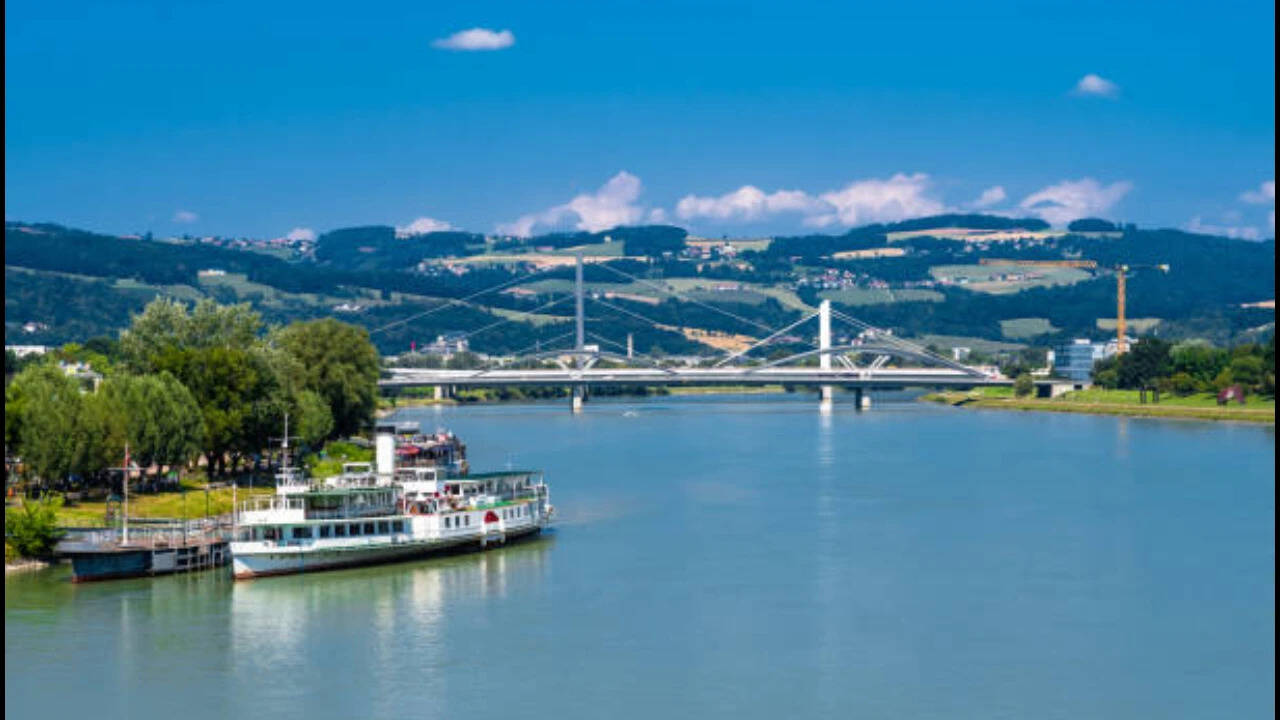
Severe droughts across Europe have pushed water levels in the Danube to historic lows. When rivers dry up, hidden stories surface. Near the village of Gigen in northern Bulgaria, stone foundations that haven't seen daylight for centuries are now poking out of the receding water.
We aren't talking about ordinary ruins. These weathered stones belong to Constantine's Bridge, a colossal 4th-century megaproject. Built by order of Emperor Constantine the Great and inaugurated in July 328 AD, this structure was a marvel of antiquity. It stretched over two kilometers total, with more than a kilometer spanning the active riverbed itself.
An Architectural Giant Lost to Time
Roman engineers didn't build small. Designed by the architect Theophilus Patricius, the bridge linked the Roman city of Ulpia Oescus in modern Bulgaria with the fortress of Sucidava in present-day Romania. It featured a wide wooden platform mounted on massive stone piers standing roughly ten meters above the ordinary water level.
For its era, it was quite simply the longest river bridge of the ancient world. Yet its glory was remarkably brief. Historical records indicate the superstructure fell out of use or suffered destruction around 367 AD, roughly four decades after its grand opening. Military shifts and changing geopolitical landscapes meant the great crossing was abandoned, leaving only its stone piers to fight the river currents.
What Scientists Are Doing With This Rare Window
Archaeologists don't get many chances to study submerged architecture without heavy scuba gear and murky underwater visibility. When regional museum teams from Pleven, led by researchers like Pavel Popov, noticed the drop, they moved fast.
They deployed drones to map the exposed masonry. Aerial photogrammetry allows experts to capture exact layouts and structural alignments that remain invisible from the muddy riverbanks. Every time the water retreats, modern science gains a sharper blueprint of ancient construction methods.
The Dark Side of Climate Shifting
While historians welcome the sudden archaeological access, the root cause is alarming. Record-breaking summer heatwaves and persistent dry spells are draining vital European waterways. The Rhine and the Danube are suffering under heavy ecological and economic strain. Cargo shipping faces severe restrictions, and surrounding agricultural sectors struggle with parched topsoil.
The appearance of Constantine's Bridge serves as a stark dual symbol. It highlights the brilliant ambition of a long-dead empire while reminding us of modern environmental volatility.
Eventually, autumn rains and upstream snowmelt will return. The Danube will swell, covering the ancient stone piers once more. Until then, researchers continue scanning the shallows, racing against the tide to preserve a chapter of history written in stone and mortar.