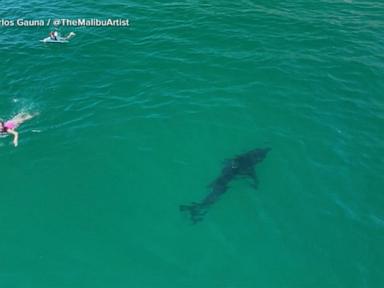
A 10-foot great white shark glides silently through turquoise water, just a dozen feet from a group of kids splashing in the shorebreak. The kids have no idea. They're laughing, jumping over small waves, completely unaware of the apex predator checking them out.
This heart-pounding scene played out along the Southern California coastline, captured from a mile away by drone photographer Carlos Gauna, known online as The Malibu Artist.
If your immediate reaction is raw terror, you aren't alone. Scenes like this make local news headlines every summer for a reason. They tap into our deepest primal fears. But if you talk to marine biologists who spend their entire lives tracking these animals, they'll tell you a completely different story.
You're looking at a normal afternoon in SoCal. The truth is simple. You've almost certainly swum near a great white shark if you've spent any real time in the Pacific surf. You just didn't have a drone hovering overhead to tell you about it.
What That Viral SoCal Drone Video Really Shows
In the recent video footage, the shark slowly approaches a group of young beachgoers. It weaves back and forth with deliberate, rhythmic tail sweeps, closing the gap until it stands just yards from the shallow surf line.
Gauna admitted that watching the scene unfold through his drone monitor made him genuinely nervous. He stood on the beach over a mile away, watching a 10-foot shark drift toward children who were completely oblivious.
Then something fascinating happened.
The shark reached the kids, circled briefly, turned around, and swam back toward deeper water.
No thrashing. No attack. No aggressive behavior whatsoever.
It was pure curiosity.
The shark was simply taking a look at strange creatures making noise in its nursery. Once it determined the kids weren't stingrays, halibut, or dead seals, it moved on.
We see this pattern repeated across thousands of hours of aerial footage shot off San Diego, Orange County, and Santa Barbara. Drones have completely altered our understanding of shark behavior. They proved that sharks inspect humans far more often than anyone ever guessed, but they almost never bite.
Why 10-Foot White Sharks Are Creeping Into Shallow Water
Why are 10-foot great whites hanging out right where people swim?
To understand this, you need to understand how white sharks grow up.
A newborn great white is about four to five feet long. At that size, they're juveniles. They can't hunt large sea mammals like elephant seals or sea lions yet because their jaws aren't strong enough, and their teeth aren't broad enough to saw through thick blubber. Instead, they eat bottom-dwelling prey. Stingrays, round rays, small fish, and leopard sharks make up their primary diet.
Where do rays live? In warm, shallow, calm water close to sandy beaches.
Southern California is a massive nursery for juvenile white sharks. Beaches in regions like Del Mar, Dana Point, Carpenteria, and Long Beach offer ideal conditions. The water is warm, the surf is mild, and the food supply is bottomless.
A 10-foot shark sits right on the edge of adolescence. It's transitioning from a juvenile to a sub-adult. It still hangs around the shallow warm water because rays are easy targets, but it's starting to venture out toward kelp beds and rocky reefs to test its luck against bigger prey.
Water temperatures play a massive role here. When coastal heatwaves hit or El Niño cycles push warm tropical water northward, white sharks arrive earlier in the spring and stay later into the autumn. Dr. Chris Lowe, director of the Shark Lab at California State University, Long Beach (CSULB), notes that warm surface water brings juvenile white sharks right up to the shoreline.
When warm water converges with crowds of summer swimmers, encounters become guaranteed.
The Science Behind SoCal Shark Nurseries
For decades, people assumed that if a great white shark swam near a beach, it was hunting humans. Hollywood built a multi-billion dollar movie genre around that fear.
The scientists at the CSULB Shark Lab decided to test that assumption using hard data instead of fear.
Over several years, researchers flew drones over Southern California beaches for hundreds of hours while tracking tagged sharks with acoustic receivers. They recorded every single interaction between white sharks, surfers, swimmers, and kayakers.
The results blew people away:
- Constant Proximity: Juvenile white sharks were present at ocean recreation sites on over 97% of the days surveyed during peak season.
- Unnoticed Encounters: Sharks were recorded swimming within 50 feet of human swimmers and surfers during thousands of separate instances.
- Zero Aggression: In almost every single case, the shark ignored the human completely or briefly approached to investigate before swimming away.
Dr. Lowe and his team even ran tests to see how sharks react to human sounds underwater. They discovered that sharks easily distinguish the low-frequency vibrations made by splashing humans from the sounds made by injured fish or sea lions.
Because humans don't look like food, smell like food, or sound like food, sharks don't treat us like food. We are basically boring obstacles in their living room.
The Big Misconception About Shark Stalking
Headlines love using words like "stalking" or "hunting" whenever a shark appears near people. It gets clicks. It builds drama.
Honestly, it's misleading.
When an apex predator like a great white actually stalks prey, it doesn't cruise lazily on the surface right in front of its target in broad daylight. A hunting white shark ambushes from below. It sits deep in dark water, uses its dark back to blend into the sea floor, and explodes upward at high speed to hit a seal from underneath.
When a 10-foot white shark drifts slowly through 4 feet of clear water near beachgoers, it isn't hunting. It's curious.
Sharks don't have hands. They interact with their environment through visual inspection, lateral line sensing (feeling vibrations in the water), and electroreception through pores on their snout called Ampullae of Lorenzini.
When a shark swims slowly toward a group of splashing kids, it's picking up electrical signals and mechanical vibrations. Once its sensors confirm that those noisy creatures are just large land mammals making a mess in the surf, it loses interest.
That isn't "stalking." That's classic animal curiosity.
Why Bites Are Dropping Even As Shark Numbers Rise
It sounds counterintuitive, but shark populations along the U.S. Pacific coast have been recovering for the past thirty years.
Back in 1994, California banned nearshore gillnets, which were accidentally killing hundreds of young white sharks every year. At the same time, federal protections for marine mammals like sea lions and harbor seals allowed seal populations to boom. More protection plus more food equals more sharks.
Yet, despite population growth and millions more people entering the ocean with surfboards, paddleboards, and wetsuits, shark bites remain insanely rare.
Your odds of getting bitten by a great white in California are roughly 1 in 11.5 million. You are literally more likely to be struck by lightning, killed by a falling coconut, or injured by a stray beach umbrella.
Why?
Because white sharks are smart. They've coexisted with humans in California waters for millennia. They've learned that we aren't part of their food chain, and drone technology is finally giving us the visual proof to accept that reality.
What You Should Actually Do If You Spot a Shark
Even with all the reassuring science, coming face-to-face with a 10-foot white shark in ocean water will turn anyone's knees to jelly.
If you spend time in the ocean, panic is your absolute worst enemy. Here is the exact protocol recommended by ocean lifeguards and shark researchers:
Keep Your Eyes on the Shark
Sharks are ambush predators. They prefer targets that don't see them coming. If you spot a shark, track its movement. Turn your body toward it. Let it know you see it.Stay Calm and Smooth
Don't thrash, scream, or splash frantically. Violent splashing mimics an injured fish in distress, which triggers a predator's curiosity. Keep your movements slow, steady, and deliberate.Back Away Toward Shore or Your Board
If you're on a surfboard, sit up high or lie down and paddle smoothly toward shore. If you're swimming, use smooth breaststrokes or sidestrokes to make your way back to shallow water.Never Swim Alone at Dawn or Dusk
Low-light conditions make it harder for sharks to identify what you are. Most predatory mistakes happen during twilight hours when visual clarity drops.Avoid Swarming Bait Fish and River Mouths
If you see birds diving rapidly into the water or schools of small fish jumping out of the sea, stay out of the water. Predators follow bait. Don't put yourself in the middle of a feeding area.
The Reality of Living Beside Apex Predators
We have to adjust our mindset.
For decades, people treated the ocean like a giant swimming pool that occasionally got invaded by monsters. But the ocean is a dynamic wild ecosystem. When you step off the sand and dive into the waves, you enter a wilderness where large predators live and hunt.
The real takeaway from drone clips isn't that California waters are suddenly unsafe. It's that white sharks have been swimming around us all along, peacefully sharing the water while we remained completely oblivious.
Respect the ocean, follow basic safety guidelines, and give these incredible creatures the space they deserve.
Check out TheMalibuArtist Great White Shark Drone Footage to see how juvenile and sub-adult great white sharks naturally navigate crowded beaches alongside swimmers and surfers without incident.